
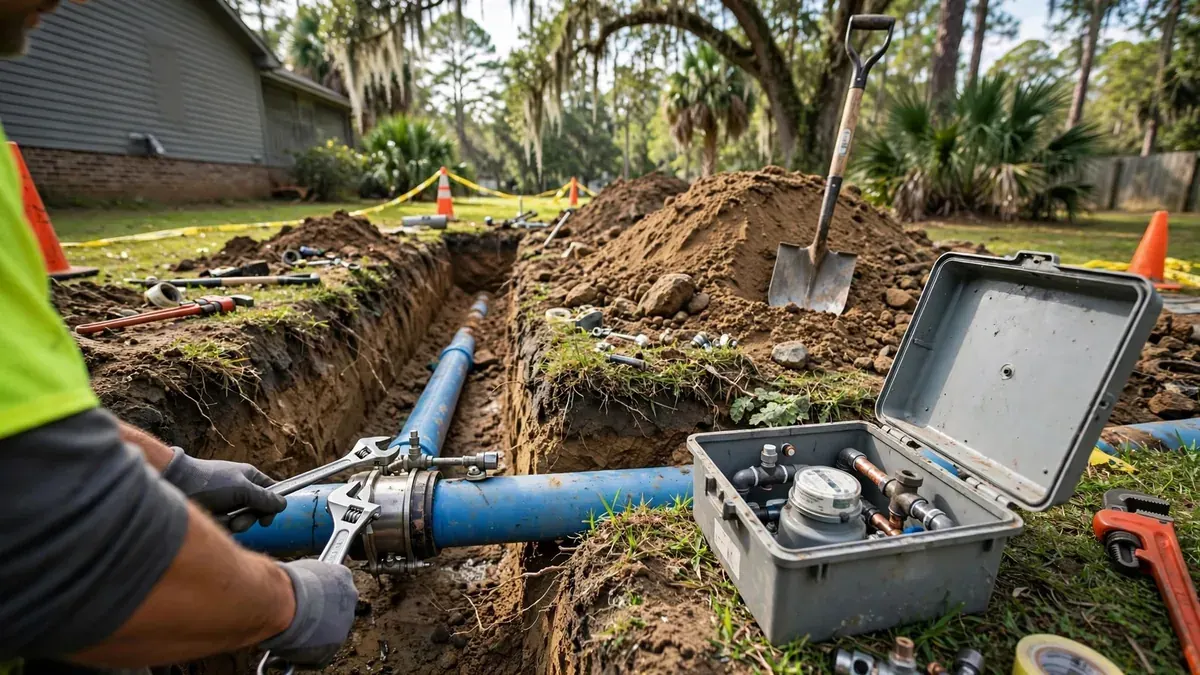
This page is about the pipe outside the walls. Plumbing inside the house is a separate job, covered under repiping, and we explain the difference below so you know which one you need.
Soggy lawn, weak pressure or a meter that never stops: signs of a service line problem
A buried line fails quietly. Water escapes into the soil, so there may be no puddle, only a lawn strip that stays wet in a dry week, a sunken patch near the meter box or a water bill that drifts upward.
Inside the house, the clue is often pressure. Showers feel weaker, a washing machine fills slowly and two taps running at once make each other worse. These signs can come from other causes, such as a partly closed valve, so a test is better than a guess.
- The meter dial moves with every fixture off and the house valve closed.
- A wet strip, a sinkhole-like dip or unusually green grass between the meter and the house.
- Water pressure that dropped across the whole house, hot and cold.
- Muddy or discolored water right after pressure changes.
- A hissing sound near the meter or where the line enters the home.
Service line or house plumbing: knowing which one you have
The service line is the single pipe running underground from the meter or curb stop to where it enters your home. The house plumbing begins at that entry point and branches to every fixture.
A leak in the service line means digging or a trenchless method outside. A leak in the house means opening walls or floors, and the fix could be a spot repair or a whole-house repipe. The meter test sorts them out: if the dial keeps moving after you close the main valve at the house, the problem is outside.
Who owns what: the meter, the curb stop and your pipe
The meter and the city-side equipment belong to the utility. If the problem is the meter itself or anything on the street side of it, call the City of Casselberry Utilities Department at 95 Triplet Lake Drive. Ask where its responsibility ends and yours begins before you pay for a repair.
On your side, the line to the house is generally yours to fix, but confirm that for your own property. The city's 2025 report says it does not have lead service lines, which is good news for the supply. It does not describe your home's own pipes.
How we confirm a buried line leak
Digging blind costs time and lawn. We find the leak first.
- We read the meter, shut the house valve and watch the low-flow indicator to confirm the leak is outside.
- A line locator traces the pipe so we know the path, depth and direction before anything is dug.
- Ground microphones and a correlator listen for the sound of escaping water and narrow the location.
- Where the sound is faint, a pressure test or tracer gas can help confirm the line.
- We mark the spot, walk you through the repair options and give you a clear price before work starts.
Low water pressure: when the line is the cause
Low pressure is a tier of its own, because the service line is only one suspect. We check the simple things first.
Valves
A main valve or meter-side valve that is not fully open can pinch the whole house.
Pressure regulator
A failing regulator near the entry can drop pressure everywhere, and it is a smaller fix than a new line.
Buried leak
A leak upstream of the house lowers pressure and raises the bill together.
Old inside pipes
Mineral build-up and corrosion in old lines can narrow the flow and point toward a repipe.
Spot dig, replacement or trenchless: choosing the repair
| Method | How it works | Best fit | Watch for |
|---|---|---|---|
| Spot dig | Excavate at the leak and replace a short section | One leak on a sound line | More leaks may appear later |
| Open-trench replacement | Dig the full path and lay a new line | Old or repeatedly failing line | Lawn, driveway or landscaping damage |
| Trenchless | Pull or burst a new line through the old path | Lines under driveways, trees or patios | Needs access pits at both ends |
| Pressure fix | Replace a regulator or valve | Low pressure with no leak found | Does not help if the line is leaking |
Yard and meter-box leaks
A box that fills with water between meter readings points to a leaking fitting, and your plumber can usually tell which side of the meter it sits on. If the leak is on the utility side, we point you to the city. Our leak detection service can trace a leak that is hard to place.
When a water line break is an emergency
Call right away if water is surfacing in the yard, flooding a garage or running toward the foundation. A broken service line can run at full pressure all day and night. A split pipe inside the walls is a different job, handled under burst pipe repair.
- Close the main valve at the house side of the meter.
- If the valve will not close, call the utility about the meter shutoff, since that valve is theirs to operate.
- Keep people and pets away from soft, washed-out soil near the break.
- Move vehicles and valuables off the low ground where water is pooling.
- Call (407) 964-8940 and describe where the water is surfacing.
What shapes the cost of a water line repair
We give you a clear price before work starts, and we explain what drives it.
Length and depth
A short, shallow leak near the house is a smaller job than a deep run across the yard.
What lies on top
Sod and mulch are easier to restore than concrete, pavers or a driveway.
Repair method
A spot dig, an open trench and a trenchless replacement are different scopes of work.
Pipe size and material
The line type and diameter decide the parts and the connections to the meter and house.
Permits and inspection
Permit rules vary, so ask the Casselberry Building Division. We work with the steps they require.
Homeowners insurance usually covers sudden and accidental damage inside the home, but typically not the failed service line, gradual leaks or wear. Some policies offer separate line coverage, so check yours.
Frequently asked questions
Yes. Our 24/7 emergency line takes these calls, and we offer same-day appointments when available. We do not promise an arrival time, but we can talk you through closing the house valve.
The meter and city-side equipment belong to the utility, so call the City of Casselberry Utilities Department about those. The line from the meter to the house is generally the homeowner's, but confirm for your property.
The city's 2025 Consumer Confidence Report says it does not have lead service lines. That describes the city system. Your home's own pipes are a separate question, so a water test is the way to know.
A water line repair fixes the buried pipe from the meter to the house. Repiping replaces the pipes inside the walls and floors. The meter test shows which one you have.
Common causes are a partly closed valve, a failing pressure regulator, or a leak in the line. We test before we recommend anything, because replacing a pipe will not fix a bad regulator.
Often yes. A spot dig reaches one leak, and trenchless methods can replace a line with two small access pits. The best choice depends on the line's condition and what sits on top. Neighbors in Winter Park face a different utility, so ask your own.
Still not sure which answer fits? Describe it to a licensed plumber.
Call (407) 964-8940Standards and sources
The City of Casselberry Utilities Department can tell you where its responsibility ends and yours begins. Service line work falls under the Florida Building Code, Plumbing (8th Edition, 2023), and MyFloridaLicense.com lets you verify a license.