
Stop all water use right now and keep your family away from the lowest drain. The more water you add, the farther the backup spreads.
Sewer backup right now: what to do while you wait
A sewer backup is a plumbing emergency because the water coming up is wastewater. Treat the wet area as contaminated, wear boots and gloves if you must walk in it, and keep children and pets out.
- Stop every water source. No flushing, no showers, no dishwasher, no laundry.
- Find your main cleanout, a capped pipe 3 or 4 inches wide, usually outside near the house or where the line leaves the property.
- Do not open the cleanout cap unless you are ready for water to flow out. Pressure behind it can release suddenly.
- Raise valuables off the floor and open windows if there is an odor.
- Call the 24/7 emergency line at (407) 964-8940 and tell us which fixtures are backing up first.
Which fixture backs up first tells us where the clog sits
A sewer line is a single pipe that every branch joins. The lowest drain in the house gives out first, because water follows the easiest path. In many homes that is a shower, a tub, or a floor drain in a laundry area.
If only one fixture is slow, the clog is probably in its own branch, and a regular cable will do. If the tub gurgles when you flush a toilet or the toilet bubbles when the washer drains, the blockage is in the main line past all those branches. Multiple fixtures acting up at once is the classic sign of a main sewer clog.
Tell us what you noticed and in what order. That information helps us decide whether to start at a branch, at the main cleanout, or at the roof vent.
Main sewer cleaning: how we clear the line
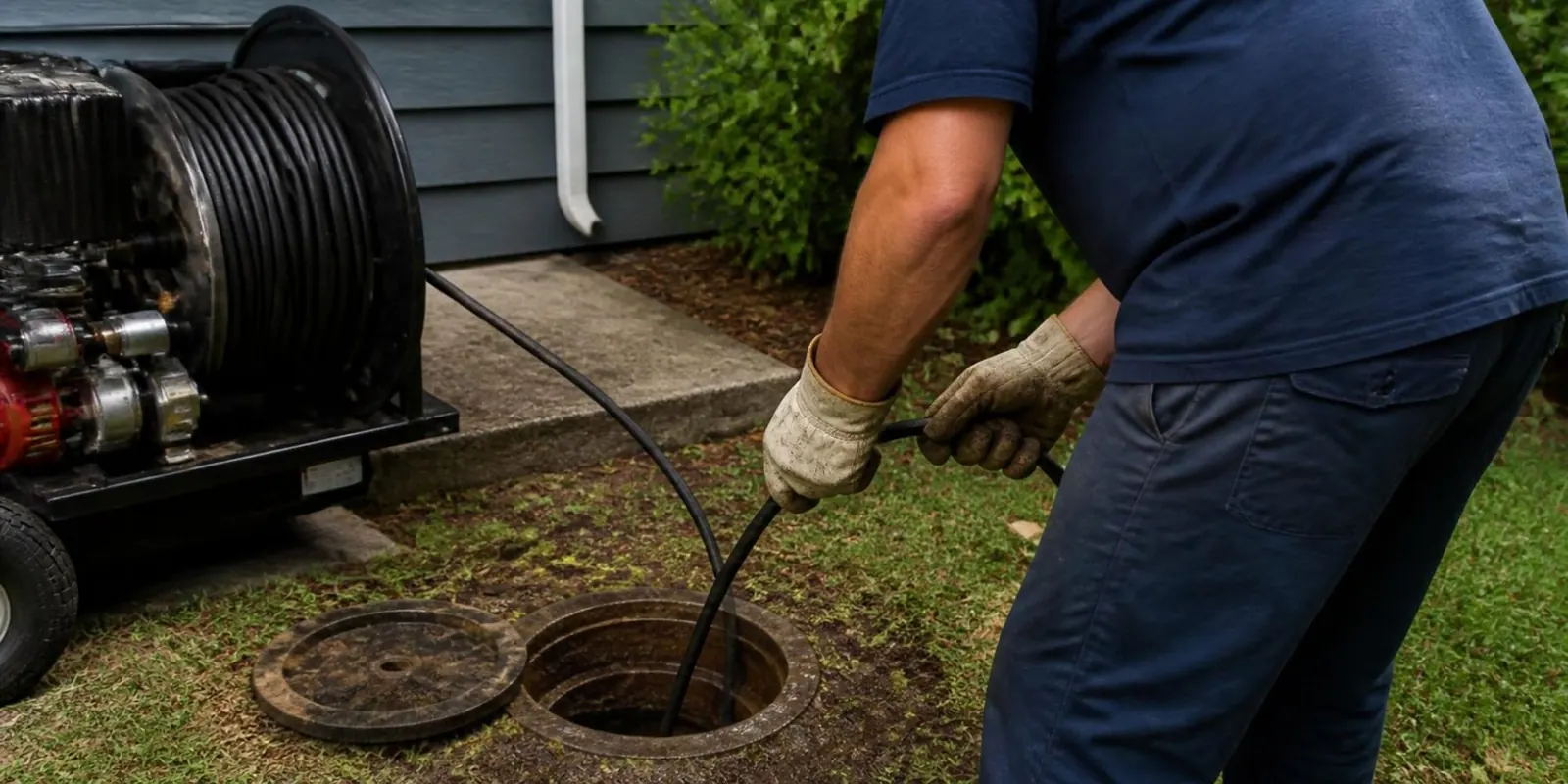
Main sewer cleaning starts at the cleanout. We feed a heavy cable, usually 5/8 inch or larger, through the cap opening toward the street. A cutting head chews through grease, paper, and roots, and the cable brings back samples that show what is blocking the pipe.
After the cable, we flush the line with water and watch for full, steady flow. When the debris is heavy grease or scale, we recommend hydro jetting to scrub the pipe wall after the cable opens it. When the cable keeps hitting something solid, we stop and run a camera so we do not force a tool against a broken pipe.
The same service goes by several names, including sewer drain cleaning and main line cleaning. They all describe clearing the pipe that leaves your house, and the method is the same.
Sewer line cleaning or sewer line repair
Cleaning removes what is in the pipe. Repair fixes the pipe itself. The signs below help separate the two.
| What you notice | Likely answer | Why |
|---|---|---|
| First backup, cable clears it, stays clear | Cleaning | A one-time blockage such as paper or grease |
| Backup returns every few months | Cleaning plus camera | Roots or buildup are regrowing and the pipe may have a gap |
| Cable keeps stopping at the same spot | Camera, then maybe repair | A break, offset or collapse blocks the tool |
| Soggy patch or sinking spot in the yard | Camera, then repair | A leak or void may sit near the pipe |
| Sewer smell outside with no backup | Camera | A cracked or open joint may be venting gas |
Where your main cleanout is and why it matters
The main cleanout is a capped access pipe that lets a plumber reach the sewer line without pulling a toilet. It is usually a 3 or 4 inch pipe with a threaded cap, sitting at ground level near the house, along a side wall, or close to the property line. Some homes have an indoor cleanout in a garage or utility room.
Finding it before an emergency saves time. Look along the foundation, near the water meter side of the lot, and under shrubs where it may be hidden. If you cannot find one, tell us, because a line with no cleanout means we may need to pull a toilet to reach the pipe.
Keep the cap clear of mulch and mowed-over soil, so the plumber can reach it quickly at 2 a.m.
When roots come back after cleaning
Roots grow toward moisture, and a sewer joint that leaks a little is a steady source of water and nutrients. A cutter clears the roots, but if the joint is still open, new root hair arrives within months. That is a repair question and not a cleaning question.
A sewer camera inspection after the first cut shows whether the roots entered through a small gap or through a major crack. If it is small, regular cleaning on a schedule may be enough. If the pipe is cracked or offset, we explain how sewer line repair options compare.
Your home might sit near Lake Howell, Lake Kathryn or one of the other 30-plus lakes and ponds in Casselberry. Trees near water often have wide, thirsty root systems, so a yard line near mature trees deserves a camera look when backups recur.
What shapes the cost of a sewer line cleaning
We give a clear price before work starts. The pieces that change it are below.
Cleanout access
A cap at ground level is quick. If we must pull a toilet, setup time rises.
Line length
A short run to the street takes less time than a long lateral.
What is in the pipe
Paper and soft debris clear fast. Packed roots or scale need cutting and jetting.
Camera inspection
Adding a camera shows the cause and helps you decide on next steps.
Time of the call
Night and weekend emergencies run through our 24/7 line with the price stated first.
Homeowners insurance usually covers sudden and accidental damage, but typically not the failed part, gradual leaks or wear. Check your policy and ask whether sewer backup is covered, since it is often a separate add-on.
Helping homes in Casselberry and neighboring Longwood
We serve Casselberry from our office on Semoran Boulevard, and we also help homeowners in Longwood, about 5 miles northwest. Whether the sewer lateral is a city line or a private connection depends on your property. For a line owned by the city, ask the City of Casselberry Utilities Department where your responsibility begins.
Frequently asked questions
Yes. Our 24/7 emergency line is open at any hour, and we offer same-day appointments when available. We do not promise an arrival time. Call (407) 964-8940 and describe what is backing up.
The shower or tub is often the lowest drain in the house, so it shows a main line blockage first. Stop all water use and call. Do not run the washer or flush toilets while you wait.
They overlap, but the pipe is different. Drain cleaning usually covers a branch line from a sink or tub. Sewer drain cleaning covers the larger main that all branches join and that leaves the house.
A healthy line may never need it. A line with a history of roots or buildup may need cleaning every so often, and a camera helps set a realistic schedule.
A plunger on a toilet is fine. A main line clog usually needs a heavy cable machine, and renting one can damage a pipe if you hit a break. We recommend calling a plumber.
We stop and show you a camera view if we can. Then we explain repair options and costs as factors, with a clear price before any repair starts.
Still not sure which answer fits? Describe it to a licensed plumber.
Call (407) 964-8940Standards and sources
Main sewer work is covered by the Florida Building Code, Plumbing (8th Edition, 2023). To confirm how your property connects to city wastewater service, ask the City of Casselberry Utilities Department. License checks are available at MyFloridaLicense.com.