
If water is actively leaking right now, shut off the main valve and call our 24/7 line. For planning a replacement, read on.
Rusty water, pinhole leaks and pressure that keeps falling
Pipes rarely fail all at once. They send small signals first, and the signals tend to repeat. Orange or brown water when a tap has sat idle points to corrosion inside steel pipe. A green crust at a copper joint or a pinhole spray in a wall points to thinning metal.
Pressure is the other tell. When the shower weakens at the same time as the kitchen tap, and the street supply is fine, the inside diameter of old pipe may have narrowed. Mineral scale and rust build up like plaque in an artery.
One of these signs is a reason to investigate. Several of them together, or a second pinhole after you fixed the first, is a reason to think about replacement.
- Rusty or discolored water that clears slowly after running the tap.
- More than one pinhole leak, or leaks at joints in different parts of the house.
- Pressure that has fallen over the years, hot and cold alike.
- Stained ceilings or walls below bathrooms and above utility rooms.
- Metallic taste or smell that your filter does not fix.
Pipe materials compared
No pipe is perfect for every home. This is a general comparison, and we talk through which fits your house, your water and your budget.
| Material | Strengths | Watch for |
|---|---|---|
| Copper | Long track record, handles heat, rigid and tidy | Can pit or pinhole, higher material cost |
| PEX | Flexible, fewer fittings, fast to run through walls | Needs sun protection and correct fittings |
| CPVC | Low cost, does not rust, rigid | Can turn brittle with age and heat |
| Galvanized steel | Found in older homes | Rusts from inside, narrows, leaks at threads |
Is your house old enough to worry about?
Casselberry's census counts jumped from 2,463 people in 1960 to 15,037 in 1980, which suggests the city grew fastest in the 1960s and 1970s. Much of its housing probably dates from the 1960s to 1980s, but that is an inference, not a fact about your house.
The county property appraiser record shows the actual build year of your home, and that is the easiest first step. A house from that era may still have its original pipes, or may already have been partly redone, so a look under the sink and in the water heater closet is worth more than the date.
Galvanized pipe replacement
Galvanized steel is coated with zinc to resist rust, but the coating wears out from the inside. Rust then builds up, the pipe narrows and sections start to leak at the threaded joints. You can often spot it by a dull gray color and a magnet that sticks to it.
Patching galvanized pipe tends to be a short-term fix, because the next section is usually in similar shape. When much of a house is on it, replacement is the more practical route.
What a repipe involves, room by room
The job follows a routine order. A good plumber plans it so the water is off for as little time as the work allows.
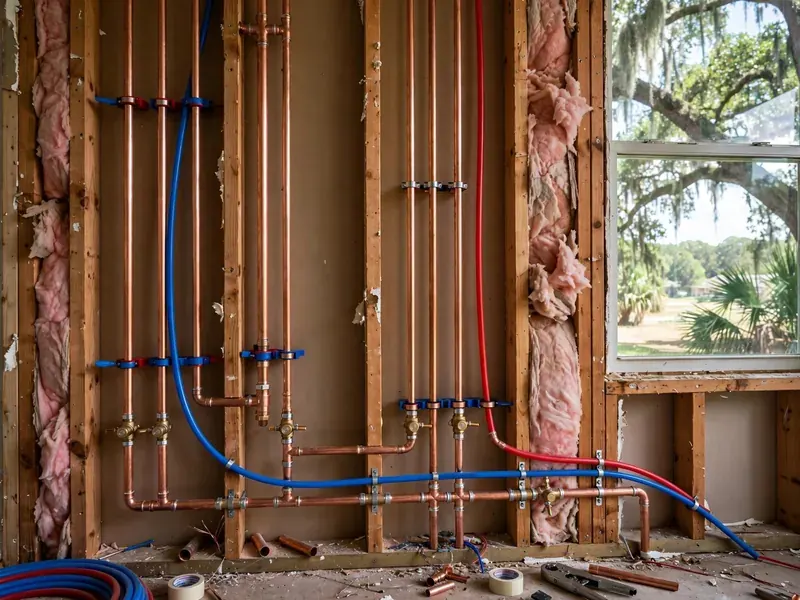
- We walk the house, find the main entry, the water heater, every bathroom, the kitchen and the laundry, and decide on a layout.
- Fixtures and shutoffs are marked, and floors and furniture in the work areas are covered.
- Small access holes are cut in drywall, usually near fixtures and in closets, to run the new lines through walls and the attic.
- New supply lines are connected to each fixture, and the old lines are capped or removed.
- We pressure test the new system before closing anything up, then restore water and check every fixture.
- Drywall patches, texture and paint are separate trades. Ask what is included before the work starts.
Drywall, dust and how long it takes
Plan for some drywall work. The more of the house we are replacing and the harder the access, the more patching you will have. Homes with attic access over most rooms need fewer cuts than homes where lines run through slab or interior walls.
Timing depends on the size of the house, the number of bathrooms and the access. Many repipes take a few days of plumbing work, with drywall repair afterward, but we do not promise a schedule until we have walked the house. Water is usually off during working hours and restored at day's end.
The city copper results are about the supply, not your pipes
Casselberry's 2025 report lists tap sampling from April 2025 with a copper 90th percentile of 0.19 ppm against an action level of 1.3 ppm, and no violation. That describes what the city supplies and how its corrosion control is working. It does not describe what your own pipes release.
A home's plumbing can still leach metals into standing water, particularly in old lines. If you are concerned, test your tap, and ask the City of Casselberry Utilities Department for its annual water quality report. The city adds orthophosphate for corrosion control, but that cannot rebuild a worn-out pipe.
Repipe, repair or reroute: how to decide
If a single pipe has failed from damage, such as a nail through a wall or a freeze, a repair is fine. See burst pipe repair for that. If a slab line has leaked, a reroute through the walls may be cheaper than repiping the whole house, and slab leak repair explains that choice.
If the buried line between the meter and the house is the problem, that is water line repair and not a repipe. The distinction matters because they are different jobs and different prices.
What to do before the repipe crew arrives
A repipe opens walls and moves furniture, so a little preparation keeps the day shorter and protects your belongings. None of it needs tools.
Plan on the water being off for part of the day, and decide where the household will wash and cook while it is.
- Clear a path to every room where a wall may be opened, including closets and the garage.
- Move furniture, rugs and wall art at least three feet away from the walls that carry pipe.
- Fill a few containers with drinking water and set aside a cooler for anything that needs to stay cold.
- Keep children and pets out of the work areas, since cut drywall, dust and fittings are on the floor.
- Take photos of walls and ceilings before work starts, so you have a record if you need it for your insurer.
- Locate your main shutoff valve and make sure it turns, then tell the plumber if it sticks.
What affects the cost of a repipe
You get a clear price before work starts. These are the factors behind it.
Size of the house
More square footage means more pipe and more fixtures to connect.
Number of bathrooms
Each bath adds supply runs, valves and wall openings.
Pipe material
Copper, PEX and CPVC differ in material cost and in labor time.
Access
Open attic space is cheaper to work in than finished ceilings or lines in a slab.
Permits and finish work
Permit rules vary, so ask the Casselberry Building Division, and patching and paint may be priced separately.
Homeowners insurance usually covers sudden and accidental water damage, but typically not the worn pipes themselves, gradual leaks or wear. A repipe done as maintenance is usually not covered, so check your policy.
Frequently asked questions
One leak on a healthy line is a repair. Repeated pinholes, rusty water or falling pressure across the house suggests the pipe is wearing out. We look at the whole system before suggesting anything.
Usually yes, though the water is off for part of each working day. Ask us about the plan for cooking, bathing and the water heater before work begins.
If the cause is narrowed old pipe, it often helps. If the cause is a failed regulator, a closed valve or a buried line leak, it will not, so we test first.
It depends on the size of the house, the bathroom count and access. Many take several days of plumbing work, followed by wall repair. We will not commit to a number until we have seen the house.
Permit rules vary, so ask the Casselberry Building Division. Contractors upload a current state license, proof of workers' compensation or an exemption, liability insurance and a business tax receipt with each application.
Yes, we serve Casselberry and nearby towns, such as Longwood and Oviedo. Call and we will confirm.
Still not sure which answer fits? Describe it to a licensed plumber.
Call (407) 964-8940Standards and sources
The City of Casselberry 2025 Consumer Confidence Report lists copper at 0.19 ppm at the 90th percentile against an action level of 1.3 ppm. That describes the city supply, and a building's own pipes can still leach metals. Repipes follow the Florida Building Code, Plumbing (8th Edition, 2023), and permit rules vary, so ask the Building Division.