
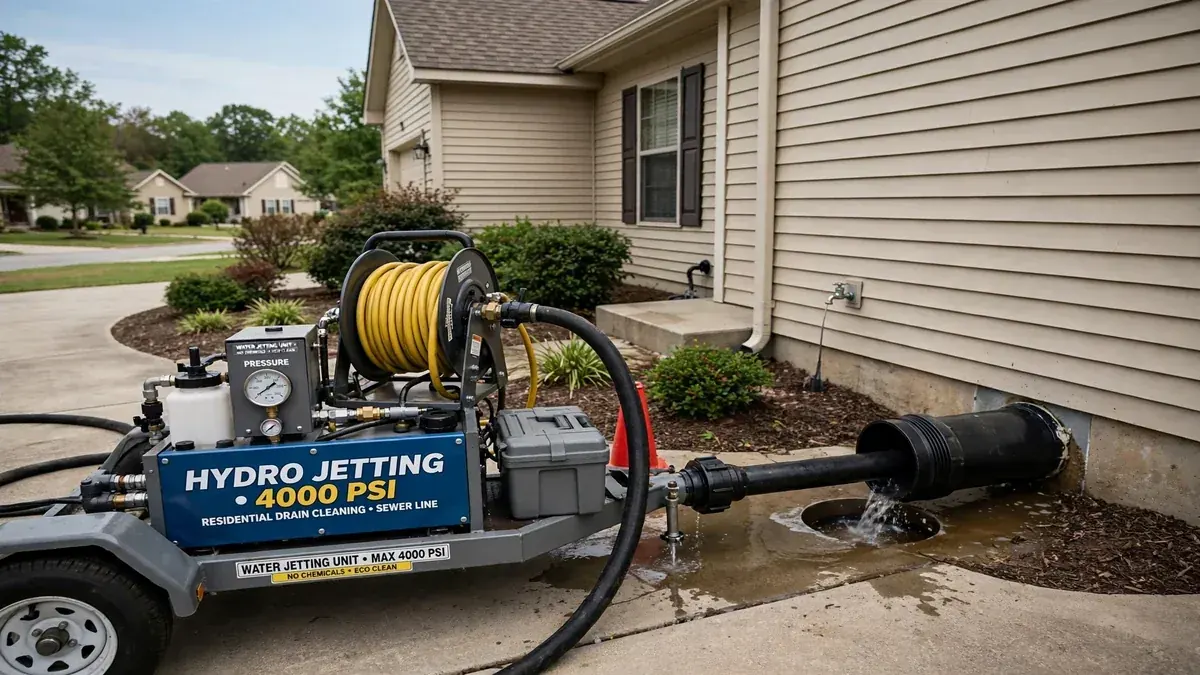
If water is rising now, stop using every fixture on that line and wait for us. Jetting needs a clear path to a cleanout, so note where yours sits.
The drain was snaked and clogged again a few weeks later
This is the most common reason people look for jetting. The plumber came, the water drained and the house felt normal for a month. Then the same sink or the same floor drain slowed down again, in the same place.
A cable punches a hole through a plug. It does not clean the pipe. The grease ring, the soap and mineral film on the wall and the fine root hairs at a joint all stay behind, and the new hole closes up as soon as the next load of debris arrives.
The fix is to clean the whole inner wall, which is what hydro jetting does. A jetting nozzle fires several angled streams that peel the buildup off and push it down the line toward the main. The pipe ends up near its original bore, so flow improves along the entire run and not only at the spot where the cable broke through.
What jetting clears that a cable does not
Grease buildup
Kitchen lines and restaurant-style drain runs collect a waxy layer. Hot, high-pressure water emulsifies it and flushes it out.
Root hair and fine roots
Roots enter at joints and grow into a mat. A cutting head removes the bulk, then jetting washes out the fine strands.
Scale and soap film
Hardened deposits narrow a pipe slowly. A rotating jet nozzle scours them off the wall.
Sludge and settled debris
Silt and paper pile up at low spots. Water pressure moves them to the main line where they can wash away.
Cable, jet or camera first: which should you pick
These three tools do different jobs, and the order matters. Starting with the wrong one can waste an appointment or push a problem deeper.
| Tool | Best for | Limit |
|---|---|---|
| Cable (drum machine) | A fresh single clog in a branch line | Opens a hole, leaves wall buildup behind |
| Hydro jetting | Repeat clogs, grease, scale, roots after cutting | Not for fragile, collapsed or badly offset pipe |
| Camera first | Unknown cause, repeat backups, older lines | Shows the problem but does not clear it |
| Cable plus camera | Backup where the pipe type is unknown | Two steps, but safer for the pipe |
| Jet after camera | Heavy buildup in a sound pipe | Needs access through a cleanout or pulled fixture |
Honest limits: when jetting is the wrong tool
Jetting is not safe for every pipe. A line that is cracked, collapsed, badly offset at a joint or separated can be damaged further by pressurized water. Water pushed into a break can also wash soil into the pipe or out around it, so a hole gets worse instead of better.
That is why we want a camera look first on an older line, on any pipe with a history of repeat backups or when we do not know what the pipe is made of. The camera shows whether the walls are sound and whether the clog is debris or a broken pipe. If the camera shows damage, we say so and talk through sewer line repair instead of selling you a cleaning that cannot fix it.
We also do not jet through a line we cannot reach safely. A pipe with no cleanout may need a fixture pulled or one installed first. If a drain just needs a cable, we will say that too.
How a hydro jetting visit goes
The process is simple, and we explain each step before we start.
- We ask which fixtures are slow or backing up, and how long the problem has returned.
- We open a cleanout or pull a fixture to get a straight path into the line.
- We run a cable or camera first when the cause is unknown, so we know what we are cleaning.
- We feed the jetting hose through the line with the nozzle spraying backward, which pulls the hose forward and scours the wall.
- We run water to confirm full flow and, when it makes sense, run a camera again to show the cleaned pipe.
When a backup is an emergency
Call right away when sewage is coming up in a shower, tub or floor drain, when every toilet in the house is slow, or when water is pooling on the floor. A backed-up line can push wastewater into your home, and it carries bacteria. Keep children and pets away from the wet area.
- Stop using sinks, showers, the dishwasher and the washing machine.
- Do not flush toilets, even if they look fine, because the water has nowhere to go.
- Move rugs and stored boxes away from the lowest drain.
- Locate the main cleanout cap outside and keep the area around it clear.
- Call the 24/7 emergency line at (407) 964-8940 and tell us whether one fixture or the whole house is affected.
When jetting is the right answer for your home
Jetting makes the most sense after a camera finds a sound pipe full of buildup. It also makes sense in a kitchen line that has had several clogs, where grease has coated the full run. It is often the right second step after a root cut on a main, because it clears the debris the cutter loosened.
Older neighborhoods around Casselberry likely have lines that are several decades old, since census growth suggests a lot of housing from the 1960s to 1980s. Check the Seminole County property appraiser record for the build year of your home. Age alone does not mean a pipe is bad, but it is a good reason to ask for the camera first.
If the main is the problem, our sewer line cleaning page explains how we handle the larger line. For a camera-only visit, see sewer camera inspection.
What changes the price of a jetting visit
You get a clear price before work starts. Here is what moves it.
Length and size of the line
A short branch takes less time than a long run to the street.
Access
A cleanout makes the job straightforward. A pulled toilet or a roof vent adds time.
Camera work
A camera look before or after jetting adds a step but protects the pipe.
Amount of buildup or roots
Heavy grease or a root mass may need cutting passes before the jet can work.
After-hours call
Emergency visits run through our 24/7 line and are priced clearly before we begin.
Homeowners insurance usually covers sudden and accidental damage, but typically not the failed part, gradual leaks or wear. Check your policy, and ask us for notes on what we found.
Serving Casselberry and nearby towns
We work across Casselberry and nearby towns, including Oviedo, where much of the growth came after 1980. Newer lines have less buildup, but roots and grease still happen. If you are unsure which tool fits, call and describe the symptom.
Frequently asked questions
Yes. Our 24/7 emergency line takes calls at any hour, and we offer same-day appointments when available. We do not promise an arrival time. Call (407) 964-8940 and say which fixtures are backed up.
On a sound pipe, no. On a cracked, collapsed or badly offset pipe, it can make the damage worse. That is why we look with a camera first on older lines and on any pipe with unknown condition.
Snaking bores a hole through the clog. Jetting scours the whole pipe wall with water. If the same drain has clogged again after a cable, jetting is usually the better next step.
Water alone does not cut thick roots. We usually use a cutting head first and then jet the line to wash out the pieces. Roots return if the pipe has a gap, so we tell you what the camera shows.
For a first-time simple clog, not always. For repeat backups, older lines or a line with unknown material, we recommend it. The camera is cheaper than damaging a weak pipe.
It depends on the line length, access and buildup. A short kitchen run is quicker than a long main with roots. We tell you what to expect once we see the cleanout and the pipe.
Still not sure which answer fits? Describe it to a licensed plumber.
Call (407) 964-8940Standards and sources
Jetting pressure and nozzle choice follow the equipment maker's instructions for the pipe material. Drain work in Florida falls under the Florida Building Code, Plumbing (8th Edition, 2023), and MyFloridaLicense.com lets you check a plumber's license.