
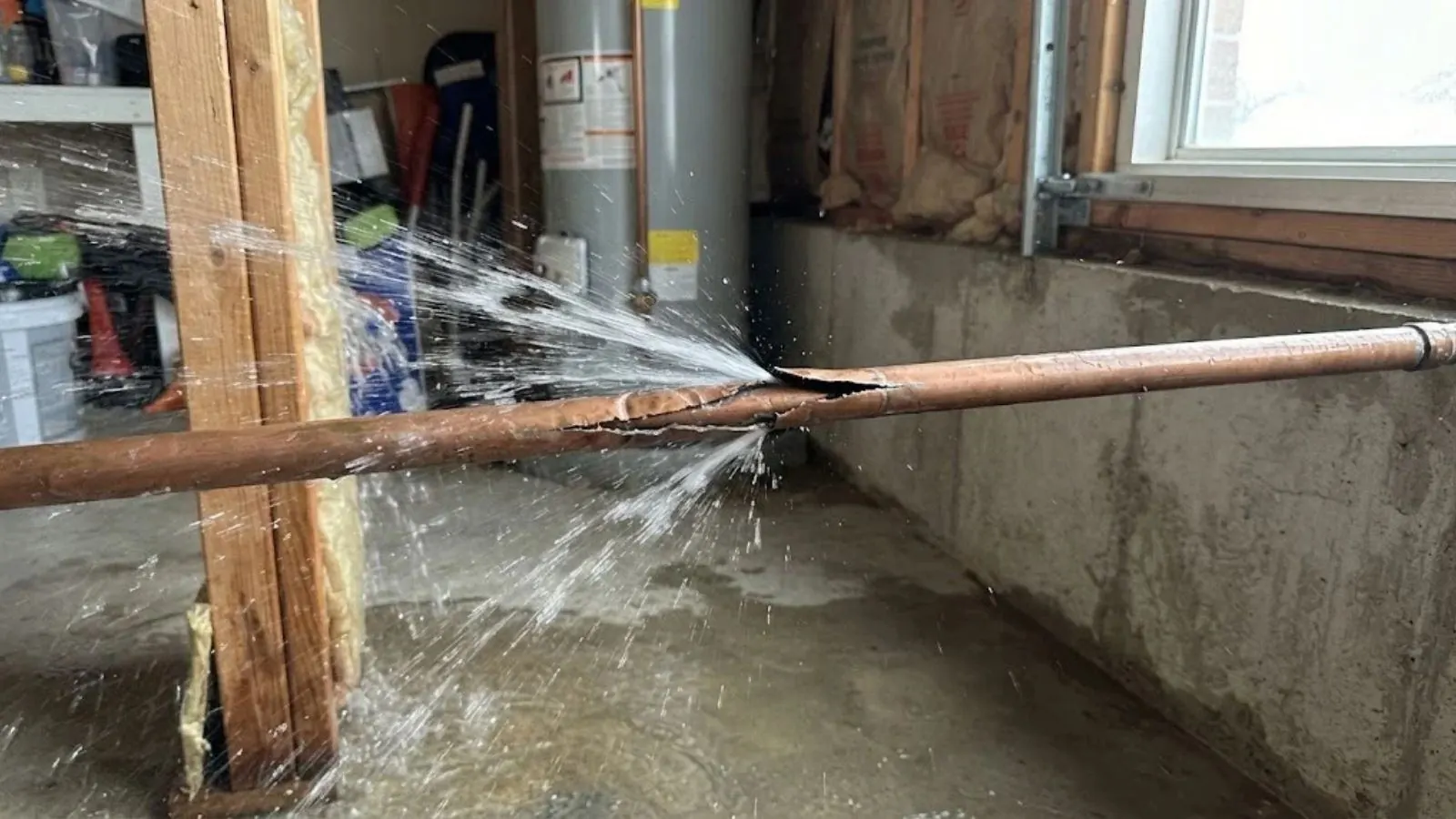
A burst pipe can release dozens of gallons a minute, so the first few minutes matter more than the repair itself. After the water is off, the job is to find out why the pipe failed and fix that, not just the hole.
When a burst pipe is an emergency
Treat any spraying, pouring or fast-dripping pipe as an emergency, especially if water is moving across a floor toward outlets or into a ceiling. Do not wait for a better time. Water in drywall and insulation starts to cause lasting damage within hours.
These steps take about two minutes and are safe for most homeowners.
- Find the main shutoff valve, often at the meter or where the line enters the house, and turn it fully closed. A ball valve closes with a quarter turn, and a gate valve needs several turns clockwise.
- Switch off the breakers for any room with wet floors, walls or ceilings, and keep out of standing water near outlets.
- Open the lowest faucet in the house, and then a few upstairs, to drain the pipes and ease pressure.
- Turn off the water heater power or gas if the burst is on the hot side, so the tank does not run dry and overheat.
- Call (407) 964-8940 and tell us where the water is coming from.
Photograph before you mop: what to document for insurance
Once water is off and the area is safe, a few photos can save a lot of back and forth later. Insurers usually want proof of what happened and when.
- Take wide shots of every wet room, then close-ups of damaged flooring, drywall and belongings.
- Photograph the burst section itself before it is cut out, including the split or crack.
- Record the water meter reading and the time you shut off the main.
- Save any damaged parts or materials until your insurer says you may discard them.
- Keep receipts for fans, towels, and any other emergency steps you pay for.
Cracked or broken pipe: why it happens and what we replace
Pipes crack from pressure spikes, age, a hard knock, shifting soil, a failed joint or corrosion that thins the wall until it gives. A hammering sound when a valve closes is a sign of water hammer, which stresses fittings over time.
Our fix depends on the break. A clean split on a straight run can be cut out and replaced with a new section and couplings. A pipe that is thin along its whole length may call for a longer replacement, since a patch only moves the weak point down the line.
We also look for the cause. If the pressure is too high, a failed regulator may need attention. If the pipe is old in several places, the answer may be repiping the affected run instead of repeated patches.
Repair methods by pipe material
Each material fails in its own way and gets repaired differently. This is a general guide, since we confirm the actual material when we look at your line.
| Material | Typical failure | Usual repair |
|---|---|---|
| Copper | Pinholes, corroded joints, split tubing | Cut out the section, sweat or press-fit new copper |
| PEX | Cracked fittings, kinks, damaged tubing | Cut and crimp or expand a new fitting and coupling |
| CPVC | Brittle cracks, failed solvent joints | Replace the section with new CPVC and solvent cement |
| PVC drain | Cracked pipe, loose or broken joints | Cut out and glue in new pipe with couplings |
| Galvanized steel | Rust-through, clogged and leaking threads | Replace the run, since patching rarely lasts |
Pipe leak repair: the slow cousin of a burst
Not every failure is a gusher. A pinhole, a weeping joint or a cracked fitting leaks slowly and can hide inside a wall for weeks. A stain that grows, a bubbling paint patch or a meter that creeps with everything off all point to this kind of leak.
If you do not know where it is, begin with leak detection so we cut only where the evidence points. If it is visible, we can often repair it the same day.
Copper pipe repair
Copper is common in houses of many ages and holds up well, but it can pit, split or fail at soldered joints. A small repair uses a coupling or a section of new tube joined by soldering or a press fitting. Soldering needs a clean, dry pipe, so the water must be off and drained first.
If the green stain of corrosion shows at several joints, we will say so. One failed joint is a repair, and a run of them is a pattern.
Drain pipe repair and broken supply valves
A cracked drain pipe does not spray, but it can soak a wall or soil for a long time. Signs include a musty smell, a slow drain that clears and returns, and a damp spot under a bathroom. Repairs typically cut out the cracked section and glue in new pipe with a coupling.
Broken supply valves are a different kind of failure. A stop valve under a sink or behind a toilet can crack or stop closing when you turn it. We replace the valve and the short supply line together, because an old line is not worth reconnecting to a new valve.
If a main or buried line is the problem, the answer lives in water line repair.
Freezes are uncommon but possible
Hard freezes are uncommon in Casselberry, but a cold snap can still happen. Exposed hose bibs, irrigation backflow assemblies and outdoor lines are the first to suffer. Insulate exposed outdoor fittings, cover backflow devices and disconnect hoses when a freeze is forecast.
What affects the cost of a burst pipe repair
You get a clear price before work starts. These factors shape it.
Pipe material and size
Copper, PEX, CPVC and PVC use different parts and methods.
Access to the break
A pipe in an open attic is quick, while one behind tile or inside a slab takes more work.
Length of the damaged run
A single split differs from a pipe that is failing along many feet.
Active flooding
A pipe that is still spraying changes how the job is staged, and you hear the price before work begins.
Related repairs
A failed shutoff valve, a pressure regulator or drywall access may be added to the job.
Homeowners insurance usually covers sudden and accidental water damage, but typically not the failed pipe itself, gradual leaks or wear. A burst pipe is often the covered kind, so call your insurer early.
Frequently asked questions
Yes. Our 24/7 emergency line is open all hours, and we offer same-day appointments when available. We do not promise an arrival time, and we will help you shut the water off while you wait.
Check near the water meter, along the front of the house, or where the line enters the garage or utility room. Learn where it is before an emergency and test it once a year so it does not seize.
If the burst is on the hot side or the tank is draining, yes. Cut power or gas to the heater so it does not heat an empty tank, and call us.
You can stop the water and use a temporary clamp or tape to slow a leak. A lasting repair needs the right material and joint, so we recommend a licensed plumber. See our water heater repair page if the tank is involved.
The resulting water damage from a sudden burst is often covered, while the pipe itself and gradual leaks usually are not. Check your policy and keep your photos.
Yes, we serve Casselberry and nearby towns, including Longwood. Call and we will tell you what is available.
Still not sure which answer fits? Describe it to a licensed plumber.
Call (407) 964-8940Standards and sources
Repairs follow the pipe maker's instructions and the Florida Building Code, Plumbing (8th Edition, 2023). What damage is covered depends on your homeowners policy, so read it or ask your insurer. License status is listed at MyFloridaLicense.com.