
If water is dripping from the unit, switch it off at the wall and shut the angle stops under the sink. A leak and a live motor together is a bad mix, and our 24/7 line can talk you through the next move.
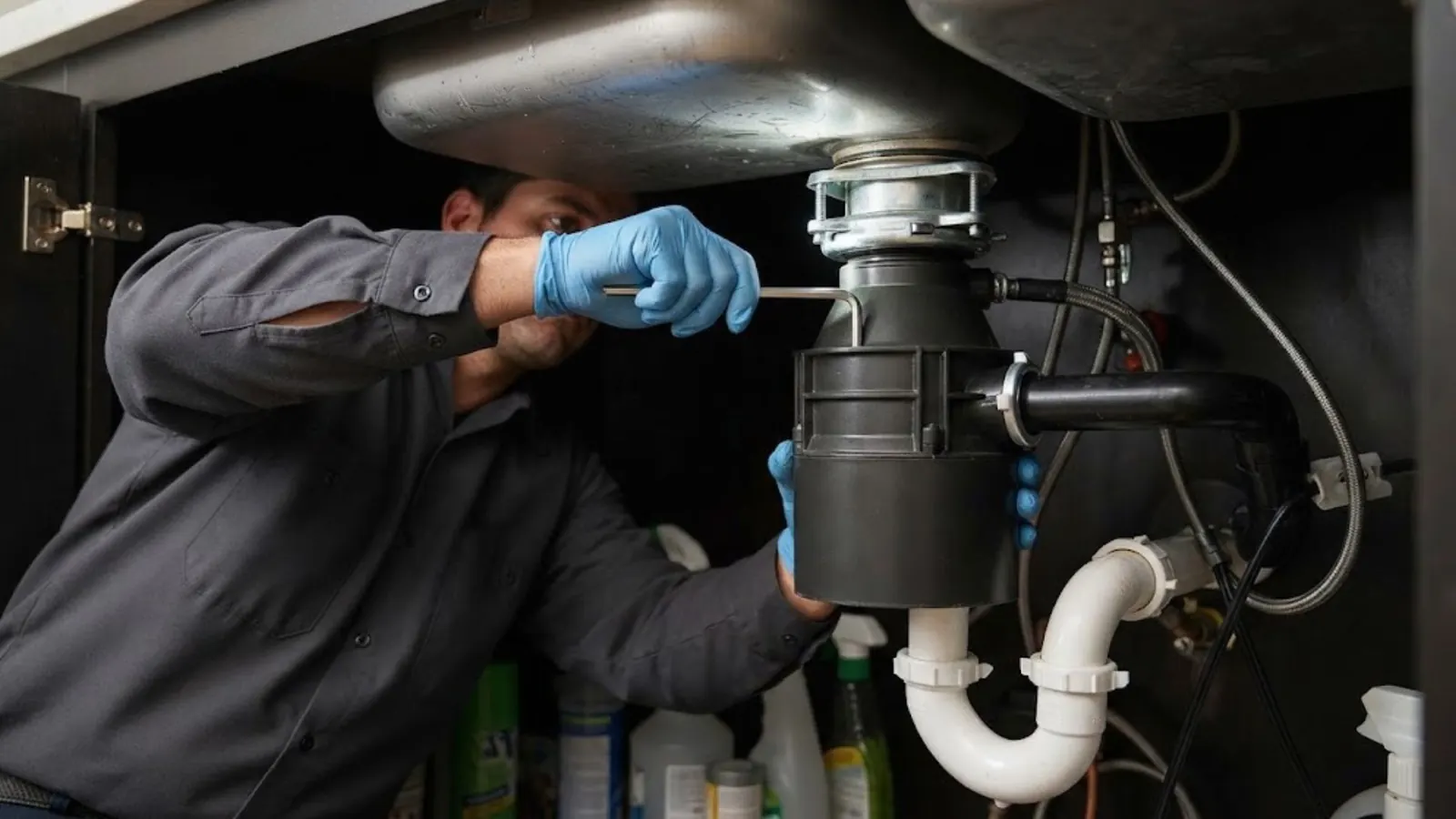
Jammed disposal: free it with a hex key
A disposal that hums but does not spin is usually jammed by a bone, fruit pit or bottle cap wedged against the grinding plate. The motor is working. It simply cannot turn.
- Switch off the wall switch, then unplug the disposal or turn off its breaker before reaching in.
- Look under the unit for a small hex socket at the very center of the bottom. Most disposals have one.
- Insert a 1/4 inch hex key and work it back and forth until it turns freely all the way around.
- From above, use tongs or pliers, never your hand, to lift out whatever was stuck.
- Press the red reset button on the bottom of the unit, restore power and run cold water while you test it.
Humming, silent or tripping: check these before replacing
Not every dead disposal is a dead motor. Work down this list before you spend money.
- A silent unit with no hum often just needs the red reset button pressed on the bottom.
- If the reset pops again right away, the motor is overheating from a jam or from running without enough water.
- A hum that never turns the blades after a hex key try can mean a seized motor or a worn bearing.
- Check that the plug is in and the breaker for the kitchen circuit or GFCI is on.
- A grinding or rattling sound with no jam usually means something metal, like a spoon, has dropped in.
Where the leak is coming from
Where the water shows up tells you what is wrong, and whether the unit is worth saving.
From the bottom
Usually a cracked housing or failed seal from the inside. This almost always means the disposal should be replaced.
From the side
Often the dishwasher hose connection or the drain outlet gasket. A hose clamp or gasket may fix it.
From the top flange
The sink flange seal or mounting ring has loosened. Plumber's putty or a mounting reseat often solves it.
From the drain pipe
A loose slip nut or worn washer on the trap. Tighten or replace the washer first.
Dishwasher connection and the knockout plug
The dishwasher drains through a small hose that connects to a side inlet on the disposal. If the water backs up in the sink when the dishwasher runs, the hose may be clogged or the knockout plug may still be inside the inlet.
A new disposal ships with that inlet sealed by a thin plug that has to be knocked out before the dishwasher hose is attached. Skipping that step is a classic reason a brand new install floods the sink.
If the drain backs up after the washing machine runs too, the blockage is deeper than the disposal. That is where drain cleaning comes in.
When a leaking disposal can't wait
Water under the sink is more than a mess. The disposal is wired, so a slow drip beside the power cord deserves quick action.
- Turn the wall switch off, then switch off the breaker that feeds the kitchen outlets.
- Close the hot and cold angle stops under the sink, and shut the dishwasher off.
- Place a bucket or pan under the leak and pull everything out of the cabinet.
- Do not run water down the drain until the leak is stopped.
- Call (407) 964-8940 and tell us whether the water is coming from the bottom, side or top.
Choosing a replacement disposal and installing it
A one third horsepower unit is fine for a single person or an occasional cook. A half or three quarter horsepower model grinds faster and jams less, which suits families. One horsepower units are quieter and better for heavy use, but cost more.
Mounting matters as much as power. Most modern units use a three-bolt quick-lock mount, so the new one often drops onto the old ring, but a different brand may need the whole sink flange reset.
Installation takes a few steps. We disconnect the power and the drain, remove the old mount, set the new flange with putty, hang the unit, knock out the dishwasher plug, reconnect the trap, and test for leaks. A new unit connected to a worn-out trap or a failing kitchen faucet and sink fittings will not look good for long, so we check those at the same visit.
What should never go down a garbage disposal
A disposal is meant for soft scraps and plenty of cold water, not for everything on the plate.
- Grease, oil and fat, which cool and coat the pipe downstream.
- Coffee grounds in bulk, which pack into a sludge in the trap.
- Celery, corn husks and artichokes, whose fibers wrap around the shredder.
- Pasta, rice and potato peels, which swell and turn to paste.
- Bones, fruit pits and shells, which jam the plate and dull the blades.
Repair, reset or replace
| Problem | What it usually means | Best move |
|---|---|---|
| Hums, no spin | Jam against the grinding plate | Free with hex key |
| Silent, no hum | Tripped overload or no power | Reset button or breaker |
| Leaks at the bottom | Cracked housing | Replace |
| Leaks at the side | Dishwasher hose or gasket | Repair |
| Leaks at the top | Loose sink flange | Reseat the mount |
| Old, noisy, repeat jams | Worn motor or bearings | Replace |
What decides the price of disposal repair or replacement
A hex-key jam clear is quick. A swap is a longer job. We give you a clear price before work starts.
Repair or new unit
A seal or hose fix costs less than a new disposal, whose price rises with horsepower.
Mounting system
A matching mount saves time. A different flange means reworking the sink opening.
Electrical setup
A switch, outlet or cord that needs attention adds to the visit.
Drain and trap condition
Corroded or leaking drain parts may need replacing while the sink is open.
Time of the call
Night and weekend emergencies are not priced like same-day appointments when available.
Homeowners insurance usually covers sudden and accidental water damage from a leak, but typically not the failed disposal itself or gradual leaks and wear. Check your policy.
Frequently asked questions
Yes. Our 24/7 emergency line is open at night and on weekends, and we offer same-day appointments when available. We do not promise an arrival time, but we will tell you how to stop the leak first.
Never. Even with the switch off, use tongs. Cut the power at the breaker or unplug it before you touch anything near the blades.
Food film coats the grinding chamber and splash guard. Grinding ice and citrus peel with cold water cleans it. A smell that stays can come from the drain line, not the unit.
It depends on how it is used and the unit itself. A unit that jams often, rattles, or leaks from the housing is nearing the end, no matter its age.
Yes. The disposal goes on one bowl, and the second bowl's drain ties into the disposal outlet or the trap. We set up the trap arm so both bowls drain freely.
The clog is past the disposal, in the kitchen branch line. A plunger may help on a sealed drain, but a clog that returns needs cleaning. We handle this in Casselberry and in towns like Oviedo.
Still not sure which answer fits? Describe it to a licensed plumber.
Call (407) 964-8940Standards and sources
Disposal installation and wiring follow the maker's instructions. The drain connections fall under the Florida Building Code, Plumbing (8th Edition, 2023). Verify a plumber's license at MyFloridaLicense.com.