
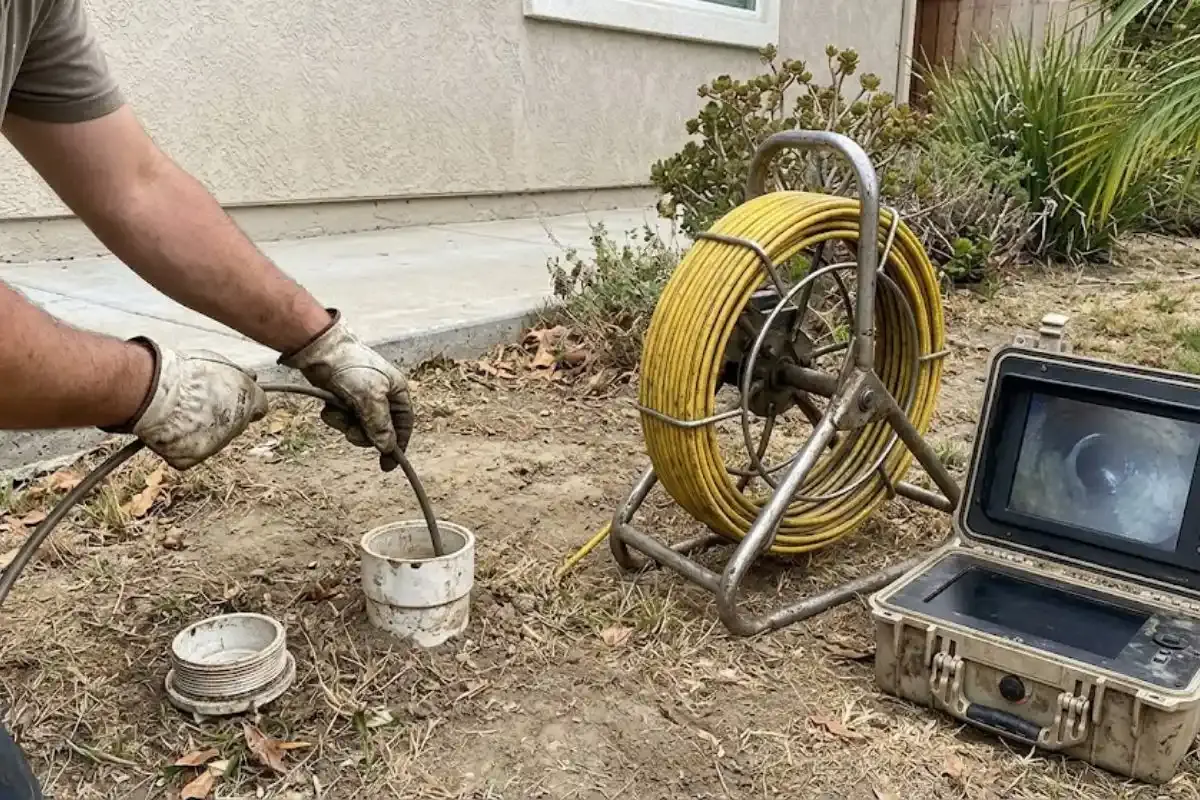
The most common question we hear is simple: do you have a camera, and can it show what is wrong? The answer is yes, with limits we explain below.
Do you have a camera, and can it show what is wrong
Yes to both, within the limits of the tool. A push camera is a lens and light on the end of a flexible rod, usually 100 to 200 feet long. It slides through the pipe while a cable carries video back to a monitor, and the footage can be recorded.
The camera shows the inside surface of the pipe: cracks, roots at joints, scale, sags where water pools, offset joints, a collapsed section and the spot where a blockage sits. It does not see through a solid wall or soil, and it cannot see the outside of the pipe.
We say plainly what we see and what we cannot, so you leave with facts and not a sales pitch.
How the camera and locator work together
The camera head carries a small transmitter. When we walk the yard with a handheld locator, it picks up the signal and shows the position and approximate depth of the head. That lets us mark a crack or a belly on the surface with paint or a flag.
A marked spot is what makes a repair plan specific. Without it, a plumber might dig a long trench to find the problem, or guess wrong and dig twice. With it, we can point to a place and say the pipe is damaged right there, about this deep.
The footage also includes a distance counter, so every defect is tied to a measured length from the cleanout.
What the visit looks like from start to finish
- We ask why you want the inspection, such as repeat clogs, a purchase or a smell outside.
- We locate the main cleanout, or pull a toilet or open a vent if there is none.
- If the line is clogged, we clear it first with a cable, because the camera cannot see through standing water or packed debris.
- We run the camera through the line, narrate what we see and mark any defects with the locator.
- We show you the recording, explain each finding and give you a clear price for anything that needs work.
Reading the findings: what the camera shows and what it means
Camera footage looks strange the first time. This table translates the common findings.
| What you see | What it usually means | Usual next step |
|---|---|---|
| Fine hair-like roots at a joint | Root intrusion through a small gap | Cutting and cleaning, then monitor |
| Water pooled in the pipe | A belly or low spot in the slope | Watch for repeat clogs, repair if it holds waste |
| Rough, flaking surface | Scale or corrosion, often in older iron | Cleaning or lining, depending on thickness |
| Shifted joint, step in the wall | Offset, often from soil movement | Spot repair if it catches debris |
| Oval or flattened pipe | Deformed or crushed section | Repair or replacement of that section |
| Clean, smooth, steady flow | Healthy line | No work needed, keep the recording |
Pre-purchase inspections for home buyers
A standard home inspection usually does not put a camera in the sewer line. The line is buried, and defects there can cost far more to fix than most visible items. A camera look before closing tells you whether the line is sound or whether you should negotiate.
Ask the seller for access to the cleanout, and schedule the visit before your inspection period ends. If the camera finds roots, a belly or a cracked section, you can ask for repairs, a credit or a lower price. If it finds a clean line, you buy with eyes open.
Census growth suggests much of Casselberry's housing probably dates from the 1960s to 1980s, so the county property appraiser record for the build year is a useful first check. Older lines are more likely to have scale, roots or joint movement. That is not a verdict, just a reason to look.
What a recording does and does not prove
A recording proves what the pipe looked like on the day we ran the camera, along the path the camera could travel. It does not prove the pipe will never fail, and it does not show sections we could not enter, such as past a collapse or around a sharp bend.
It also does not tell you the pipe material for certain, though the look and joints often hint at it. Treat the footage as a dated record. Keep it with your closing papers or your maintenance file, and compare it to a later inspection if you suspect change.
When a camera look is the right next step
A camera is worth the visit when a drain clogs again after cleaning, when several fixtures drain slowly, when you smell sewage outside or when a patch of lawn is soft over the line. It also helps before you pay for trenchless lining or replacement, so the work covers the right length.
If the problem is a plain kitchen or tub clog, drain cleaning is enough and a camera may not be needed. If the camera shows buildup in a sound pipe, hydro jetting can scrub the wall clean. If it shows damage, we walk you through sewer line repair choices with the footage in front of you.
We also inspect lines for homeowners in Fern Park, which borders Casselberry, so call even if your address is just over the line.
What affects the cost of a camera inspection
We give a clear price before work starts. These factors shape it.
Access to the line
A clean outdoor cleanout is quick. Pulling a toilet or opening a vent adds time.
Cleaning first
If the pipe is clogged, we clear it before the camera can see anything.
Length of line
A short run to the street takes less time than a long lateral.
Locating and marking
Marking defects above ground with a locator adds time but pays off in repair planning.
Recording and notes
A saved recording with notes is useful for a sale, a negotiation or a later comparison.
Homeowners insurance usually covers sudden and accidental damage, but typically not the failed part, gradual leaks or wear. A dated recording can help you document a claim, so ask us to save it.
Frequently asked questions
No. It sees what is in front of the lens, and standing water or packed debris blocks the view. We may clear the line first so the camera can travel.
Ask us when you book. We can review it with you on site and discuss saving a copy, which is handy for a sale, a negotiation or an insurance conversation.
A push camera usually reaches a few hundred feet at most, depending on bends, joints and debris. Sharp turns and collapsed sections can stop it. We tell you where it stopped and why.
No. It means the pipe was sound along the path we ran on that day. Roots, soil movement or age can change things later, so keep the recording for comparison.
It is a smart step, because a standard home inspection often does not cover the buried line. Schedule it inside your inspection period so you can negotiate if it finds a problem.
Not from a camera alone. Confirm your connection type with the City of Casselberry Utilities Department or county records. We handle the line, not tank pumping unless we say so.
Still not sure which answer fits? Describe it to a licensed plumber.
Call (407) 964-8940Standards and sources
A camera inspection reports what the camera sees and is not a code inspection. For permit or code questions, ask the City of Casselberry Building Division. Any plumber's license can be verified at MyFloridaLicense.com.