
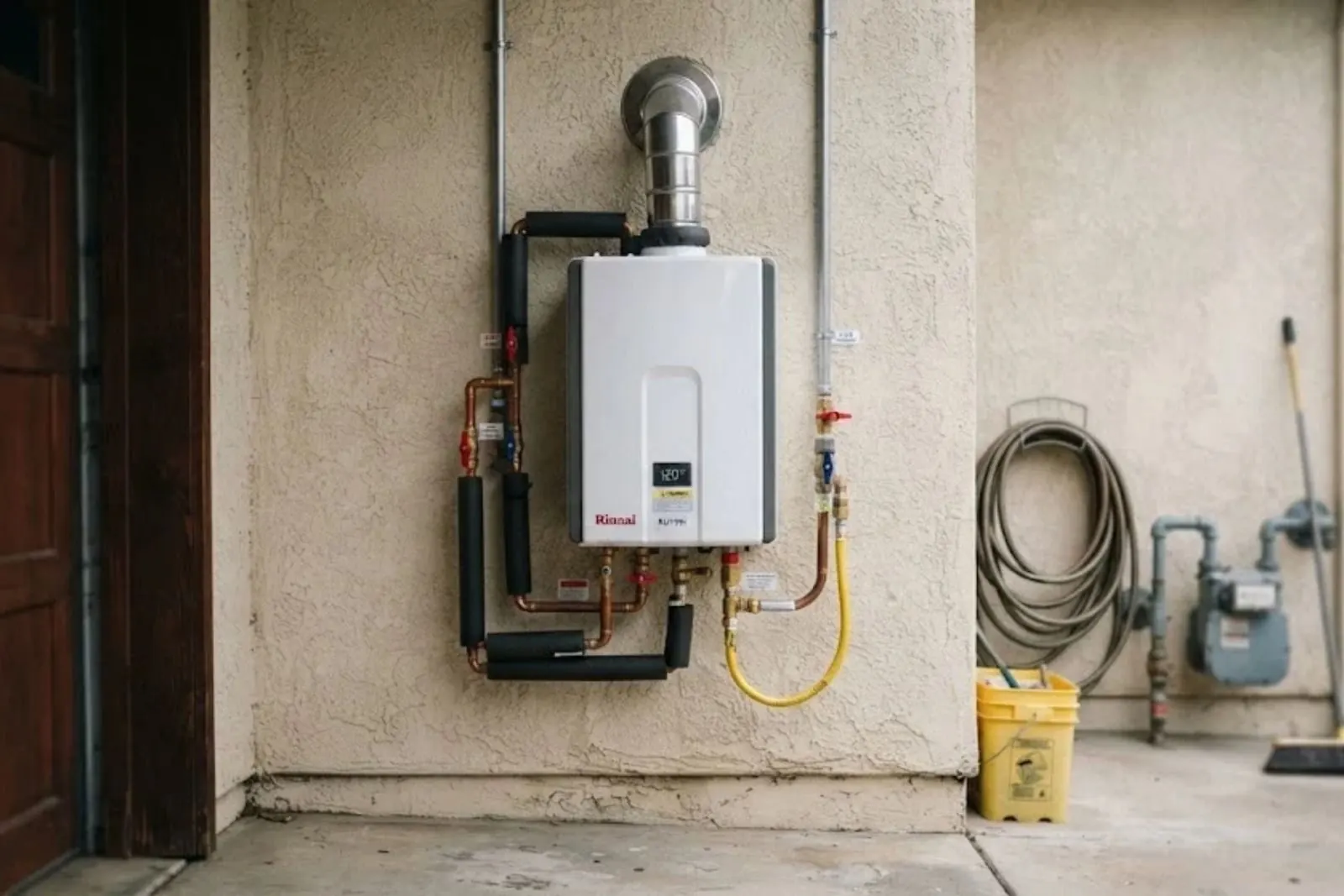
Our licensed plumbers install tankless units, flush them and diagnose the faults. Same-day appointments are available when the schedule allows, and the 24/7 emergency line covers leaks and gas smells.
Hot water runs out mid-shower, or you get a cold sandwich
A tankless heater should not run cold in the middle of a shower. When it does, the cause is usually one of four things.
The unit is undersized
Every unit has a flow limit in gallons per minute. Two showers and a dishwasher at once can pass it, and the heater cannot keep the water hot.
Scale on the heat exchanger
Mineral buildup narrows the passages and the unit overheats or shuts down. A flush often clears it.
Low flow can fall below the minimum
Some units will not fire when a tap runs very low, which causes the cold sandwich: hot, then cold, then hot again.
An error code
The display usually points to ignition, venting, flame or temperature trouble. Write the code down before you reset it.
Tankless water heater flush and descale
A flush circulates a mild acid solution, usually white vinegar or a descaling product the maker approves, through the heat exchanger to dissolve scale. It uses a small pump and two hoses connected to the service valves on the unit.
How often to do it depends on your water and the manufacturer instructions. We do not quote a schedule that fits every home. Test your tap, read your unit's manual, and ask the City of Casselberry Utilities Department what it can share about the water at your address.
Warning signs include rumbling or popping, a lower flow, longer waits for hot water and a rising count of error codes. A flush takes a couple of hours and also lets us clean the inlet screen, which catches grit before it reaches the exchanger.
Error codes and symptoms: what they usually mean
Codes differ by maker, so your manual is the authority. This table covers common patterns.
| Symptom | Likely cause | First move |
|---|---|---|
| Cold sandwich between hot bursts | Low flow or a dirty inlet screen | Clean the screen, check the shower flow |
| Ignition failure code | Gas supply, igniter or flame sensor | Check that the gas valve is open, then call |
| Overheat or temperature code | Scale or restricted flow | Schedule a flush |
| Venting or exhaust code | Blocked or loose vent run | Turn it off and call |
| Water too cool at full flow | Demand above the unit's capacity | Run fewer fixtures at once |
What a tankless install requires
Tankless gas units draw a lot of fuel in a short burst, so the gas line often needs to be larger than the one that fed your old tank. A line sized only for a storage heater may starve a tankless one at full demand.
Venting is just as important. Most gas tankless units use sealed stainless or plastic venting that the maker specifies, and condensing models produce acidic condensate that needs a drain and sometimes a neutralizer. Electric units skip the gas and vent but need a very heavy circuit and panel capacity. Plan to ask for a load check on your panel.
Before you buy a tankless unit
- Count the fixtures that may run at the same time, and note any large tub.
- Check your gas meter and line size with a plumber before you buy a high-input unit.
- Ask where the vent will exit and where the condensate will drain.
- Plan for service valves so the unit can be flushed without a drain-down.
- Compare lifetime upkeep, not only the purchase price, since flushing is part of owning one.
What service means when a shop only replaces
Some shops swap a tankless unit as soon as it throws a code. We diagnose first. Many codes trace to a dirty inlet screen, a closed valve, a clogged exchanger or a loose vent joint, and those are fixable.
We also tell you plainly when a unit is past saving. If the heat exchanger has failed or the control board and several parts are gone, replacement through our water heater replacement service may make more sense.
What shapes the cost of tankless work
We state your price clearly before work starts.
Unit type and capacity
Gas, electric and condensing models differ, and higher flow rates cost more.
Gas line and venting changes
A larger gas line or a new vent path can be a big part of the job.
Service access
Isolation valves for flushing add parts now and save time later.
Existing condition
Heavy scale, damaged screens or failed sensors affect a repair.
Permit and inspection
Permit rules vary, so ask the Casselberry Building Division.
Homeowners insurance usually covers sudden and accidental damage but typically not the failed part, a planned upgrade or gradual leaks and wear. Check your policy.
Is tankless right for your house?
A tankless unit makes sense when floor space is tight, when the family is large and showers stack up, or when the old tank is failing and the gas line can support the switch. A standard tank still wins for homes with a simple setup and a modest budget. Our page on water heater installation lays out sizing for both types.
If your heater is already leaking, start with water heater repair. Homeowners in Winter Park live in Orange County with its own building department, so see our Winter Park page for how that works.
Frequently asked questions
The most common causes are demand above the unit's flow limit, scale on the heat exchanger or a very low flow that does not keep the burner firing. A flush and a flow check often fix it.
It depends on your water and the manufacturer instructions. Check the manual, test your tap, and ask the City of Casselberry Utilities Department what it can tell you.
Codes vary by maker. Most point to ignition, flame, venting, flow or temperature trouble. Write the code down and send it to us, since it helps us bring the right part.
Often yes. Tankless gas units draw more fuel at once than a tank, so the line must be checked against the unit's input rating.
Yes. Bring the model number and any error code. If the unit lacks service valves, we can add them.
It is worth it when you value endless hot water and saved space and your home can support the gas, venting and electrical needs. A tank is still the simpler choice for many households.
Still not sure which answer fits? Describe it to a licensed plumber.
Call (407) 964-8940Standards and sources
Tankless manufacturers publish the venting, gas supply and clearance requirements for each model, and installation follows them along with the Florida Building Code, Plumbing (8th Edition, 2023). Verify the installer's license at MyFloridaLicense.com.