
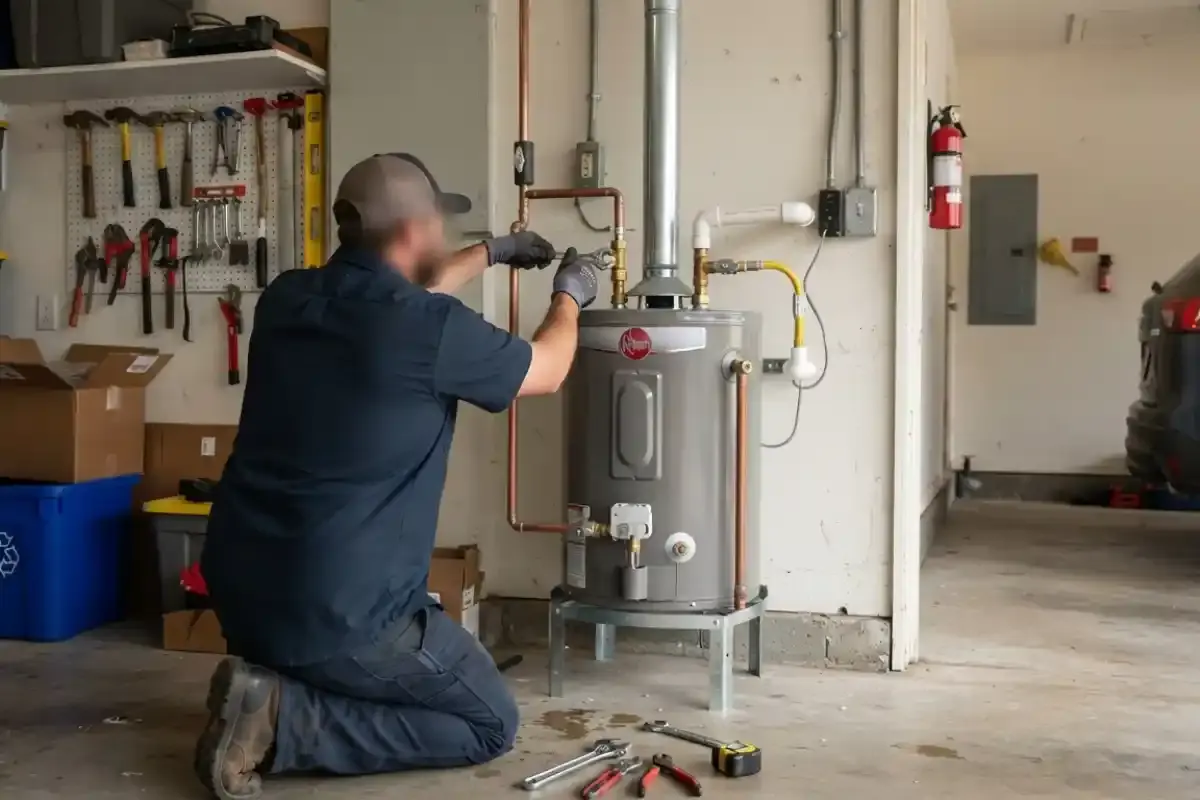
Pick the size before you pick the brand
Most homes run a 40 or 50 gallon tank. A 40 gallon unit suits one or two people with a single bathroom in daily use. A 50 gallon unit fits three or four people, and larger families or homes with a soaking tub do better at 65 to 80 gallons.
Read the first-hour rating on the yellow EnergyGuide label, because it shows how much hot water the tank delivers in a busy hour. Two tanks with the same gallon number can perform quite differently. A taller, narrower model may also fit a closet that a short, wide one will not.
Gas or electric: what changes in the install
| Item | Gas tank | Electric tank |
|---|---|---|
| Fuel connection | Gas line with a sediment trap and shutoff | Dedicated 240 volt circuit and breaker |
| Venting | Flue to the outdoors with correct slope | None needed |
| Recovery speed | Faster, so a 40 gallon gas tank can feel larger | Slower, so size up for big households |
| Install site | Needs combustion air and clearances | More flexible, but needs clear access to panels |
| Switching fuels | Adds new wiring if you move to electric | Adds a gas line and venting if you move to gas |
How a scheduled install goes, start to finish
A planned install is calm, and most of the work is preparation. Here is the usual order.
- We check the old unit's label, fuel, vent path, pan and shutoffs, then confirm the new size and parts with you.
- We shut off water and fuel, drain the old tank into a floor drain or hose run outdoors, and disconnect it.
- We set the new tank on a level base or pan, then connect new flex lines, shutoff valves and a relief valve discharge pipe.
- We connect the gas and vent or wire the electric supply, then fill the tank with a hot tap open so air escapes.
- We test for leaks, check vent draw or power, set the thermostat and walk you through the shutoffs.
Venting and combustion air for gas heaters
A gas water heater burns air as well as fuel. It needs enough fresh air in the room and a vent that carries exhaust outside with a steady upward slope. A closet with a closed door and no air openings is a classic trouble spot.
Backdrafting is the danger, because it can pull exhaust gases back into the home. We check the draft at the vent hood after install, and we follow the manufacturer instructions and the Florida Building Code, Plumbing. If a vent looks rusted, loose or poorly sloped, we will point it out before it becomes a safety question.
Small parts that protect the whole setup
Expansion tank
Heated water expands. In a closed system with a check valve or pressure reducer, an expansion tank gives it a place to go and spares the relief valve.
Drain pan and drain
A pan under the tank catches slow leaks and sends them to a visible drain, so you see trouble before the wall does.
Discharge pipe
The relief valve's pipe must run downward to a safe spot, with no cap, no plug and no threaded end.
Shutoffs and flex connectors
A full-port ball valve above the tank and braided flex lines make later repairs a ten-minute job instead of a house shutdown.
First-day checks after the install
Give the new heater a careful first day. These checks take only a few minutes.
- Look at every joint on top of the tank once the water is hot, and dab any damp spot with a dry tissue.
- Run the hot tap at the farthest fixture and confirm the water warms up.
- Set the thermostat at the level the installer chose, and ask about scald risk before raising it.
- Note the install date and take a photo of the label and serial number.
- Listen for hissing or rumbling in the first week, since new tanks should run quietly.
What shapes the price of an installation
Your price is stated clearly before work starts. These factors move it.
Tank size and efficiency
Bigger and more efficient tanks cost more, and heat pump hybrids sit at the top of the range.
Existing connections
A clean swap in the same spot is simple. Moving the heater means new gas, water and vent runs.
Venting and air supply
A gas vent that needs replacing or a closet that needs added combustion air changes the scope.
Safety and code add-ons
Expansion tank, drain pan, discharge pipe and strapping and clearance needs depend on the site. Permit rules vary, so ask the Casselberry Building Division.
Access
An attic or tight closet takes longer than an open garage.
Homeowners insurance usually covers sudden and accidental damage, but typically not the cost of a planned upgrade, a worn-out heater or gradual leaks. Check your policy.
Related planning questions
If your old tank is leaking or already dead, our emergency replacement service moves faster than a planned job. If you wonder whether a repair on a younger tank is enough, read about repairing a failing water heater first.
On-demand heating changes the install, so look at how tankless units are installed before you commit. Homeowners in Oviedo and nearby areas can also see our Oviedo service page for travel details from our Semoran Boulevard office.
Frequently asked questions
A 40 gallon tank handles one or two people, and a 50 gallon tank handles three or four. Check the first-hour rating on the label too, since recovery speed matters as much as tank size.
If your home has a closed system, usually from a backflow preventer or pressure reducing valve, an expansion tank is a smart addition. We check the system and tell you if yours needs one.
Yes, but it adds work. A new location means new water lines, a new vent or circuit, and a drain for the pan. Tell us the spot you have in mind and we will look at the route.
Permit rules vary, so ask the Casselberry Building Division. The division is at 95 Triplet Lake Drive, open Monday through Thursday, and it has an online permit portal.
A like-for-like tank swap often takes a few hours. Moving a unit, changing fuel types or adding venting takes longer and may need two visits.
Look for drips at the top connections, confirm that hot water reaches the farthest tap and make sure the discharge pipe is uncapped. Keep the install date handy for future service.
Still not sure which answer fits? Describe it to a licensed plumber.
Call (407) 964-8940Standards and sources
An installation follows the manufacturer's instructions for gas, electric or heat pump models and the Florida Building Code, Plumbing (8th Edition, 2023). Ask the City of Casselberry Building Division how permits apply to your address, and confirm the installer at MyFloridaLicense.com.