
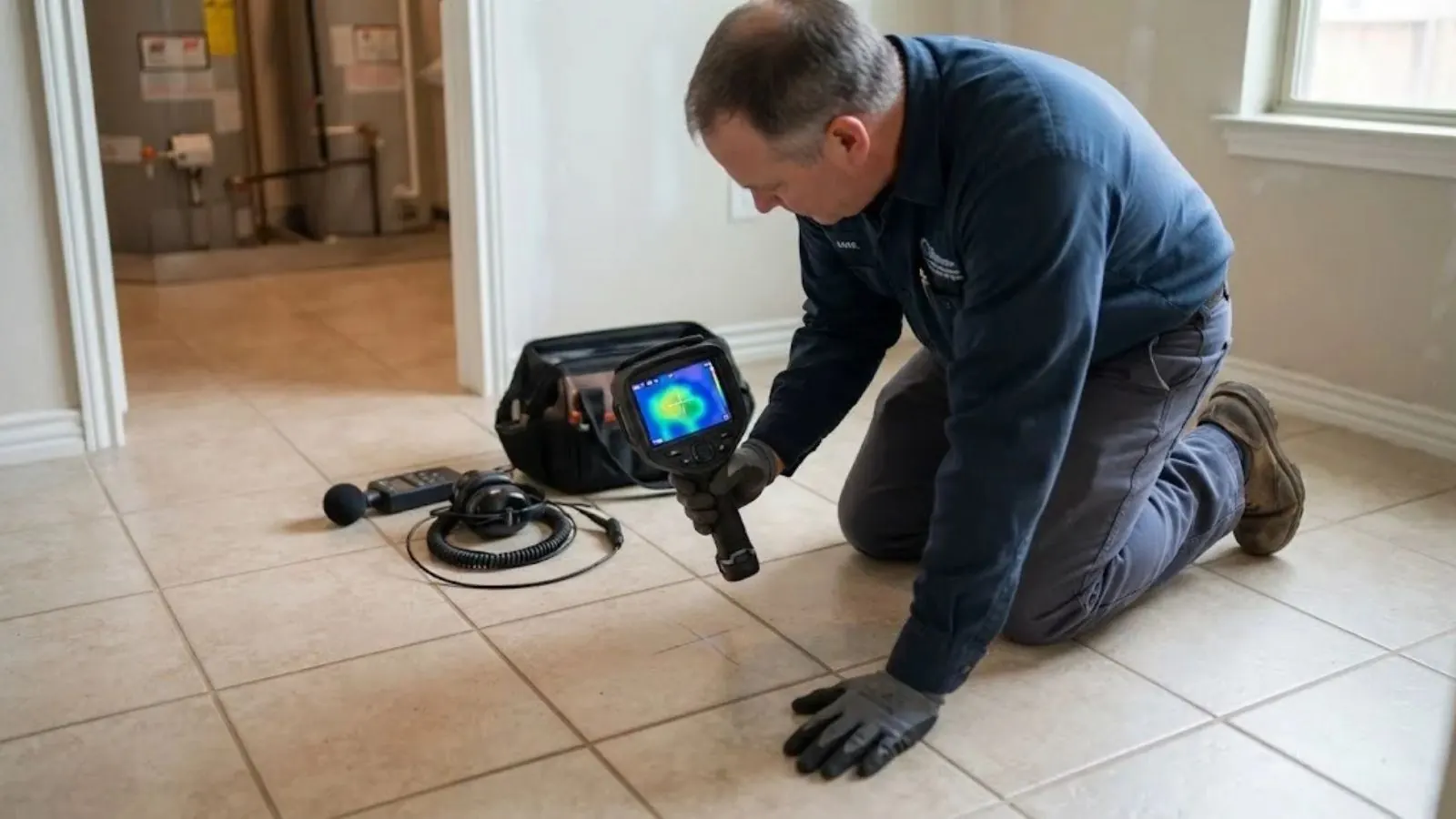
Most hidden leaks are not dramatic. They show up as a number on a bill, a faint musty smell, or a spot of floor that feels warmer than the rest. This page walks through the signs, a meter test you can run yourself, and how each kind of leak is located.
Meter still turning with everything off? Other signs of a hidden leak
A leak you can see is easy. The costly ones sit behind drywall, under a slab, or in a buried line, and they announce themselves in small ways. Home supply lines run at roughly 40 to 80 psi, so even a pinhole pushes water out all day and night.
If any of the signs below sound familiar, run the meter test in the next section before you call. It takes about ten minutes of work plus a short wait, and it tells us whether the leak is on your side of the meter.
- The meter dial or low-flow indicator keeps moving when every fixture and appliance is off.
- Your water bill has crept up for two or three cycles with no change in how the household uses water.
- A damp spot, stain or bubbling paint shows up on a ceiling or wall with no obvious source.
- One patch of floor feels warm, which can point to a leaking hot water line.
- You hear a faint hiss or trickle in a quiet house, or the water heater seems to refill when nobody used hot water.
- A patch of lawn stays soggy or greener than the rest, even in a dry week.
The ten-minute meter test
Your meter is the cheapest leak detector you own. The point is to make the whole house stand still so only a leak can move the dial.
- Open the meter box and wipe the lid of the register so you can read the dial. Many meters have a small triangle or star on the face that spins at the slightest flow.
- Shut off every tap, the dishwasher, the washing machine and the ice maker. Check that no toilet is running and that irrigation is not on a timer cycle.
- Write down the full reading, including the small sweep hand, or take a photo of the dial.
- Watch the low-flow indicator for two minutes. If it is turning, water is moving somewhere.
- Wait 30 to 60 minutes with nothing in the house in use, then read the meter again.
- If the number changed, close the main valve at the house and check the meter once more. A dial that stops points to a leak inside the house, and one that keeps moving points to the buried line between the meter and the house.
Water bill creeping up with no obvious cause
A gradual rise is the signature of a slow leak, and the most common culprit is a toilet. A worn flapper lets water seep from the tank into the bowl, and the fill valve tops it up again without a sound. Drop a few drops of food coloring in the tank, wait 15 minutes without flushing, and look for color in the bowl.
Dripping faucets, a stuck ice maker valve and a water heater relief valve that weeps are the next suspects. Those are all visible and cheap to check.
If the toilets are clean and the meter still moves, the loss is hidden. That is when listening gear and pressure testing earn their keep, because guessing means opening walls in the wrong place.
Stains, bubbles and soft spots on ceilings and walls
Water travels. A brown ring on a ceiling is often below the real leak, because water runs along a joist or a pipe before it drips. A bubbled patch on drywall near a bathroom might come from a supply line, a shower valve, a drain connection or a leaking tub overflow.
We start by mapping moisture with a meter that reads through surfaces, then use a thermal camera to see temperature differences that show where wet material is cooling. A hot water line that leaks looks warm, and a cold line that leaks looks cool.
Then comes the sound check. A listening device on the wall or fixture picks up the hiss of a pressurized line, and a pressure test on an isolated branch confirms it. The result is a small, marked access cut instead of a large demolition.
If the pipe in that wall has failed in several places, a repair is only a patch. We will tell you when the better answer is replacing the piping in the house and let you decide.
Slab homes and raised floors: what to check on yours
Slab foundations are common in central Florida, though not universal, so check how your own house is built. A home on a concrete slab can have supply lines running through or under it, and a leak there sends water up through flooring or into the soil. That case has its own page on slab leak repair.
Homes on a raised floor have a crawl space or a pier-and-beam layout that lets us look at the lines from below. That is easier, and often means a leak can be confirmed by eye, with a light and a dry rag. If you are not sure which type you have, the property appraiser record or a look around the foundation edge will tell you.
Buried line leaks between the meter and the house
The service line runs underground from the meter to your home, and you own the part on your side. The meter test above is the first clue. If the dial moves with the house valve closed, the leak is between the two.
To pin it down, we use a line locator to trace the pipe's path, then ground microphones and a correlator to hear the leak noise at two points and calculate where the sound meets. Tracer gas is another option on lines that are hard to hear, since a safe hydrogen and nitrogen mix escapes through the leak and shows up at the surface with a sniffer.
Once the point is marked, a small spot dig usually beats a long trench. If the line itself is old or damaged in more than one place, replacement is worth pricing. The full range of options sits on our water line repair page.
Sprinkler and irrigation leaks
A broken head or a cracked lateral can waste thousands of gallons a month and look like a normal wet lawn. Watching the zone valves one at a time, we look for a pressure drop on a single zone, which narrows the search to one run of pipe.
Two Casselberry facts matter here. The city has 42 miles of reclaimed water main, but only in some areas, so ask the City of Casselberry Utilities Department whether your street can connect. Where reclaimed water is not available, a separate irrigation meter can lower the bill, because irrigation water is not charged sewer treatment fees, per the city.
Watering is not allowed from 10 a.m. to 4 p.m., so a noon timer breaks the rules and loses water to heat. Allowed days depend on your address and the time of year, so check the city page.
Pool, spa, yard box and commercial leaks
Pool and spa: a pool can lose water to evaporation, so the bucket test comes first. Mark the water level inside and outside a bucket on a step, run the pump normally, and compare after a day. If the pool drops faster than the bucket, the loss is a leak in the shell, skimmer or plumbing, and we only handle the supply and plumbing side, not liner or shell repair.
Yard and meter box: a box full of water after the lid was dry can mean a leaking fitting on your side of the meter. If the leak is on the utility side, the meter and city equipment belong to the utility, so call the City of Casselberry Utilities Department about those.
Commercial: a business has more lines, longer hours and tighter downtime, so we can locate leaks with the same listening and pressure methods but may need to work around operating hours. Be honest with us about shared walls and tenants, and see our commercial plumbing page for the full scope.
Which method finds which leak
No single tool finds everything. We pick based on what you see and where the pipe runs.
| Method | What it does | Best for |
|---|---|---|
| Acoustic listening | Hears the hiss of a pressurized pipe through floors and soil | Slab, wall and buried lines |
| Thermal imaging | Shows temperature differences behind surfaces | Hot water leaks, wet ceilings |
| Pressure testing | Isolates a line and watches a gauge for drops | Confirming a suspected branch |
| Tracer gas | Pushes a safe gas through the line and sniffs for it | Quiet leaks and hard-to-hear lines |
| Line locator | Traces where a pipe runs underground | Marking a buried line before digging |
| Moisture mapping | Reads dampness inside drywall and flooring | Narrowing a ceiling or wall stain |
What you see and what to do first
| What you notice | Likely area | Your first move |
|---|---|---|
| Meter moves, house valve closed | Buried service line | Mark the meter reading and call |
| Meter stops when house valve is closed | Inside the house | Run the toilet dye test, then call |
| Warm floor spot | Hot line under or in the slab | Shut off the water heater and call |
| Wet ceiling stain | Supply or drain above | Turn off the main and power to that room |
| Soggy lawn strip | Irrigation or service line | Turn off the sprinklers and retest the meter |
| Bill up, nothing visible | Toilet or hidden line | Run the meter test above |
When a leak is an emergency
Call right away if water is pouring, a ceiling is sagging, or water is near outlets or the electrical panel. A hidden slow leak is not as urgent, but a leak that grows while you wait gets more expensive.
Do what is safe while the plumber is on the way.
- Close the main shutoff valve, usually at the house side of the meter or near where the line enters the home.
- Switch off breakers for wet areas and stay out of standing water near outlets.
- Open the lowest tap in the house to drain the line and relieve pressure.
- Move furniture and rugs, and put a bucket under any drip.
- Take photos of the damage and the meter before cleanup, then call (407) 964-8940.
What affects the cost of finding a leak
We give you a clear price before work starts. Several things change what the visit looks like, and we explain them up front.
Where the pipe runs
A line under a concrete slab or beneath a driveway takes more equipment than one in an open wall.
How many methods are needed
A loud leak may need listening only, while a quiet one can call for pressure testing and tracer gas together.
Access to the area
Finished tile, built-in cabinets and tight attics slow the search.
Size of the property
More fixtures and longer runs mean more lines to isolate and test.
Repair afterward
Finding the leak and fixing it are separate jobs, and the repair depends on the material and location.
Homeowners insurance usually covers sudden and accidental water damage, but typically not the failed pipe itself, gradual leaks or wear. Check your policy, and ask your insurer whether leak location work is covered.
Frequently asked questions
Yes. Our 24/7 emergency line is staffed around the clock, and we offer same-day appointments when available. We do not promise an arrival time, but we will tell you what to do with the main valve and power while you wait.
It means water is moving somewhere beyond the meter. Close the main valve at the house and watch again. If the dial stops, the leak is inside the home, and if it keeps spinning, the buried line is the likely source.
Often yes. Acoustic gear, thermal imaging and pressure tests narrow the spot down so the access cut is small. Some leaks still need an opening to repair, but we aim to cut only where the evidence points.
No. Seasonal watering, guests or a new appliance can raise usage. The meter test separates real leaks from habits. If the dial moves with everything off, it is a leak.
The meter and city-side equipment belong to the utility, so call the City of Casselberry Utilities Department about the meter itself. The service line on your side of the meter is usually the homeowner's responsibility. Homeowners in nearby Fern Park ask the same question, and the answer there is to confirm with your own utility.
Sudden and accidental damage is often covered, but a gradual leak or worn pipe typically is not. Read your policy and call your insurer before repairs, and keep photos and the repair invoice.
Yes, damp drywall and insulation can grow mold within a few days to a couple of weeks. Drying quickly after a leak is as important as fixing it, and a burst line may also need burst pipe repair.
Still not sure which answer fits? Describe it to a licensed plumber.
Call (407) 964-8940Standards and sources
Leak location methods follow each equipment maker's instructions. For questions about your bill or meter, ask the City of Casselberry Utilities Department. A plumber's license can be verified at MyFloridaLicense.com.