
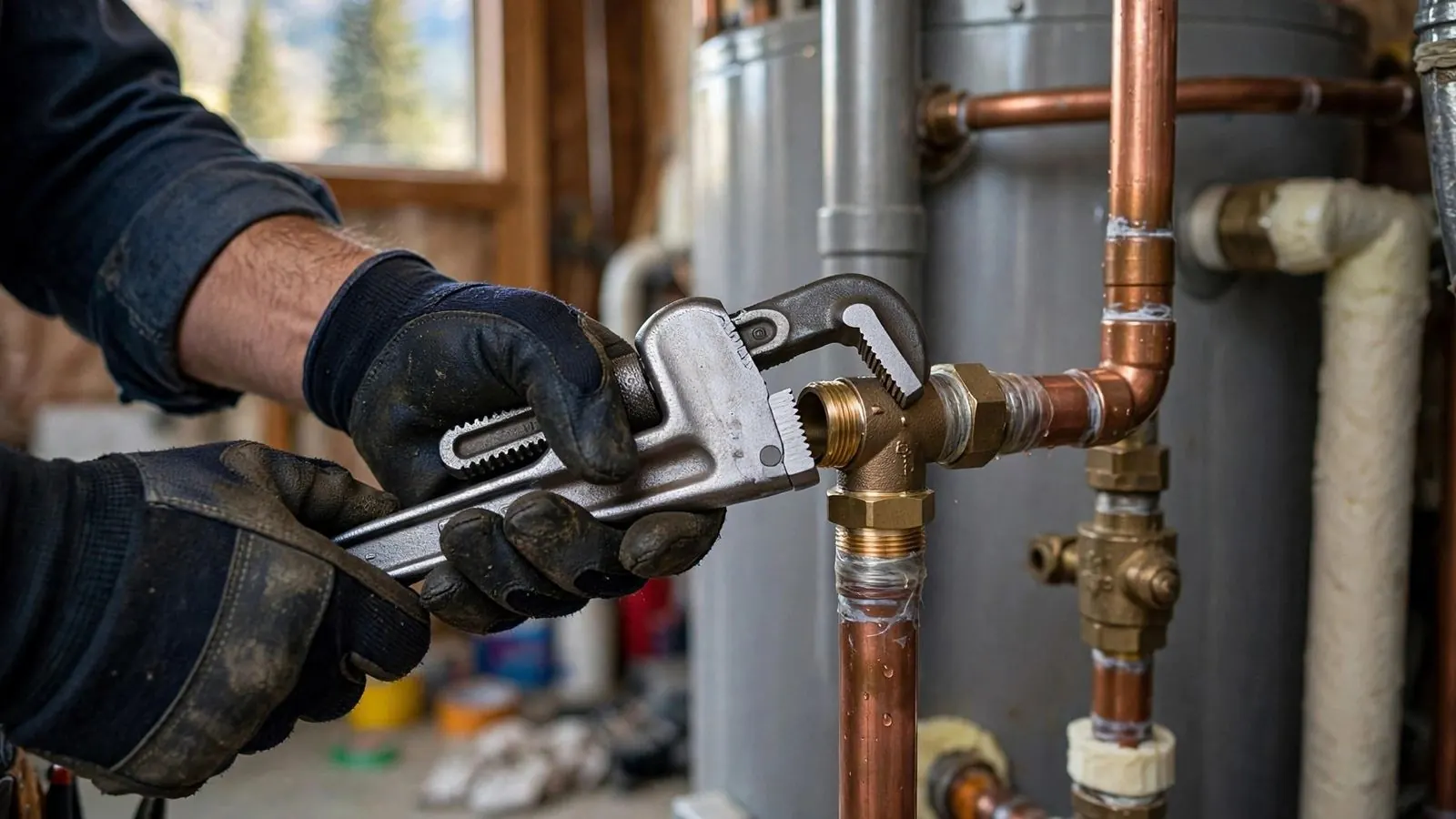
While you wait, shut the cold water valve on top of the heater and turn off its power or gas. That stops the flooding and the heat. A tank full of hot water can scald, so keep kids and pets away from the drain valve and the discharge pipe.
Water heater leaking: tank, fittings or relief valve?
A water heater leak comes from one of five places. They are the tank itself, the cold inlet and hot outlet fittings on top, the temperature and pressure relief valve, the drain valve near the floor, and the supply lines beside the unit. Water follows metal and drips from the lowest point, so the puddle often sits far from the real source.
Fittings and valves are repairable. A drip at a top connector or a weeping drain valve usually needs a new part, not a new heater. A leak from the tank seam or bottom edge is a different story. Rust eats through the steel shell from the inside, and no patch holds against normal household pressure.
Here is a quick sort. Dry the tank and floor, then wrap dry toilet tissue around each fitting and wait ten minutes. Wet tissue at the top points to a connection. Water from the discharge pipe beside the relief valve points to pressure or heat trouble. Dampness along the jacket or bottom rim points to the tank.
When a leaking water heater is an emergency
A slow drip into a pan can wait for a daytime visit. A steady stream, a hissing sound, a ceiling stain below the heater or any smell of gas cannot. A 40 or 50 gallon tank can empty onto a floor in a few minutes once the shell splits.
- Turn the cold water supply valve on top of the heater clockwise until it stops, or close the main shutoff if that valve is stuck.
- Switch the heater's breaker off for an electric unit, or turn the gas control knob to OFF for a gas unit.
- If you smell gas, leave the house, do not touch light switches, and call the gas utility from outside.
- Move boxes, shoes and cardboard away from the water, and run a wet vacuum or mop so it does not wick into walls.
- Take photos of the tank label and the wet area, then call our 24/7 line and describe where the water is coming from.
A puddle under the tank or a wet garage wall
A heater in a garage or utility closet often leaks where nobody looks. Water slides under the tank, wicks into the bottom of the drywall on the shared wall, and appears as a stain or a swollen baseboard in the next room. By then the leak may have run for weeks.
Press a dry paper towel against the base of that wall. If it comes away damp and the heater is dry, the water may be coming from a supply line, not the tank. A pinhole in the line is a different job, and our leak detection work traces hidden water with sensors before anyone opens a wall.
No hot water at all: five checks before you call
No hot water is usually a failed part, not a dead tank. These checks are safe for most homeowners and take about fifteen minutes.
- Check the breaker for an electric heater, because a tripped double-pole breaker kills both elements.
- Press the red reset button behind the upper thermostat panel only after the breaker is off, then restore power.
- On a gas heater, look through the viewing window for a pilot flame, and relight it only if the label shows you how.
- Run the hot tap for two minutes, because a closed or half-open hot outlet valve is a surprisingly common cause.
- Note whether the water is lukewarm or ice cold, since that clue tells us which element or burner part to bring.
Electric, gas and heat pump heaters fail in different places
The part that fails depends on how the heater makes heat, so the first question on the phone is always the fuel type.
Electric tank
Two heating elements and two thermostats sit behind small panels. A burned lower element gives lukewarm water that runs out fast. A dead upper element or thermostat often means no hot water at all.
Gas tank
A pilot light, a thermocouple that proves the flame, a burner and a gas control valve do the work. A pilot that keeps going out often points to a worn thermocouple or a draft problem.
Heat pump (hybrid) unit
A compressor and fan on top pull heat from the surrounding air. A clogged air filter or a blocked condensate drain can shut it down, and backup elements cover the gap when it does.
The tank behind it all
Every type has the same steel tank and anode rod. Once the shell leaks, the parts around it are not worth chasing.
Rotten-egg smell from the hot water only
A sulfur smell can come from the water supply or from the heater. Casselberry's utility says it aerates well water to reduce sulfur odor at the plant. So if the smell shows up only on hot taps and the cold side smells clean, the heater is a likely suspect, though a plumber should confirm.
Inside the tank, a magnesium or aluminum anode rod protects the steel by corroding first. Bacteria that feed on that reaction can make hydrogen sulfide gas, and a warm tank gives them a place to live. Swapping the anode rod or flushing the tank sometimes ends the odor.
If the rod is eaten down to the core wire and the tank is old, replacement may be the smarter spend. If every tap smells, including cold ones, ask the City of Casselberry Utilities Department what it can tell you about your area.
The relief valve is a safety part, not a nuisance
The temperature and pressure relief valve opens if the tank gets too hot or the pressure climbs too high. It is the last defense against a tank rupture. Never cap it, plug it or screw a fitting into its outlet, even if it drips.
A valve that drips after each heating cycle often signals thermal expansion in a closed system, and an expansion tank may be the fix. A valve that runs constantly or spits steam means the tank is overheating, so turn the heater off and call. Lift the lever briefly once a year to confirm it moves, and keep a bucket handy.
Repair or replace: a decision table by symptom and tank age
Tank age changes the math. Most tank heaters are built for roughly 8 to 12 years of service, and the date is printed on the label near the serial number.
| Symptom | Tank age | Usual call |
|---|---|---|
| Lukewarm water, runs out fast | Under 8 years | Repair: test and replace the lower element |
| No hot water, breaker fine | Under 12 years | Repair: thermostat or upper element |
| Pilot keeps going out | Any age | Repair: thermocouple or burner cleaning |
| Drip at top fitting or drain valve | Any age | Repair: new connector or valve |
| Water seeping from tank shell | Any age | Replace: the tank has failed |
| Rumbling, rust-colored hot water | Over 10 years | Flush first, plan to replace soon |
| Several parts failing in a year | Over 10 years | Replace, since each fix buys less time |
What decides the cost of a water heater repair
You get a clear price before work starts. These are the things that move that number up or down.
The failed part
A thermocouple or a drain valve is a small repair. A gas control valve or a heat pump component is a bigger one.
Fuel and tank type
Electric, gas and heat pump units use different parts, and some are harder to source on short notice.
Access and location
A tank in an open garage is quick to reach. A closet or tight utility space adds time.
Tank age and condition
On an older tank we may recommend replacing it, because a repair on a tired tank can be money spent twice.
Flushing and code items
Sediment removal, a discharge pipe fix or an expansion tank may be added. Permit rules vary, so ask the Casselberry Building Division if a larger job is planned.
Homeowners insurance usually covers sudden and accidental damage, such as a burst tank flooding a room, but typically not the failed part itself or gradual leaks and wear. Check your policy before you decide.
What we repair and when we will say stop
We repair electric and gas tank heaters and the common parts on heat pump units. If your heater has a leaking shell or a rusted-through base, we will say so plainly and talk through a replacement the same week rather than sell a repair that will not last.
If you are leaning toward a different type of heater, our page on tankless water heaters explains what that switch involves. Homeowners in nearby towns can also reach us from our Longwood service page, and anyone planning a fresh install can read about planned water heater installation.
Frequently asked questions
Yes. Our 24/7 emergency line is staffed day and night, including weekends. Same-day appointments are available when the schedule allows, and we do not promise a specific arrival time. Shut off the water and the power or gas first, then call.
Top leaks usually come from the cold inlet or hot outlet connectors, a loose nipple or the relief valve. Those are often repairable. Water running down the outside of the tank can come from the top and look like a tank leak, so dry everything and watch where the first drop forms.
On an electric unit the likely causes are a tripped high-limit reset, a failed thermostat or a burned element. On a gas unit the pilot or thermocouple is the usual suspect. A tank that is full of sediment can also heat poorly, though that usually shows as lukewarm water first.
A small drip at a fitting can wait a day or two with the supply valve closed between uses. A leak from the tank shell cannot, because it tends to get worse quickly. Never use a heater whose relief valve is blowing steam.
It can be done, but it is a design decision, not a repair. A heat pump unit needs space and airflow, a condensate drain and usually a 240 volt circuit. Ask us about it when you talk through replacement.
Sometimes. If the odor is only on hot water, a new anode rod or a tank flush can help. If the tank is badly corroded or the smell returns within weeks, replacement is usually the cleaner answer.
Look at the serial number on the rating label. Many manufacturers encode the month and year in the first four characters, though the format differs by brand. If it is unclear, send us a photo of the label and we will read it.
Still not sure which answer fits? Describe it to a licensed plumber.
Call (407) 964-8940Standards and sources
Water heater work follows the manufacturer's instructions for your model and the Florida Building Code, Plumbing (8th Edition, 2023). Check a plumber's license at MyFloridaLicense.com before work begins.