
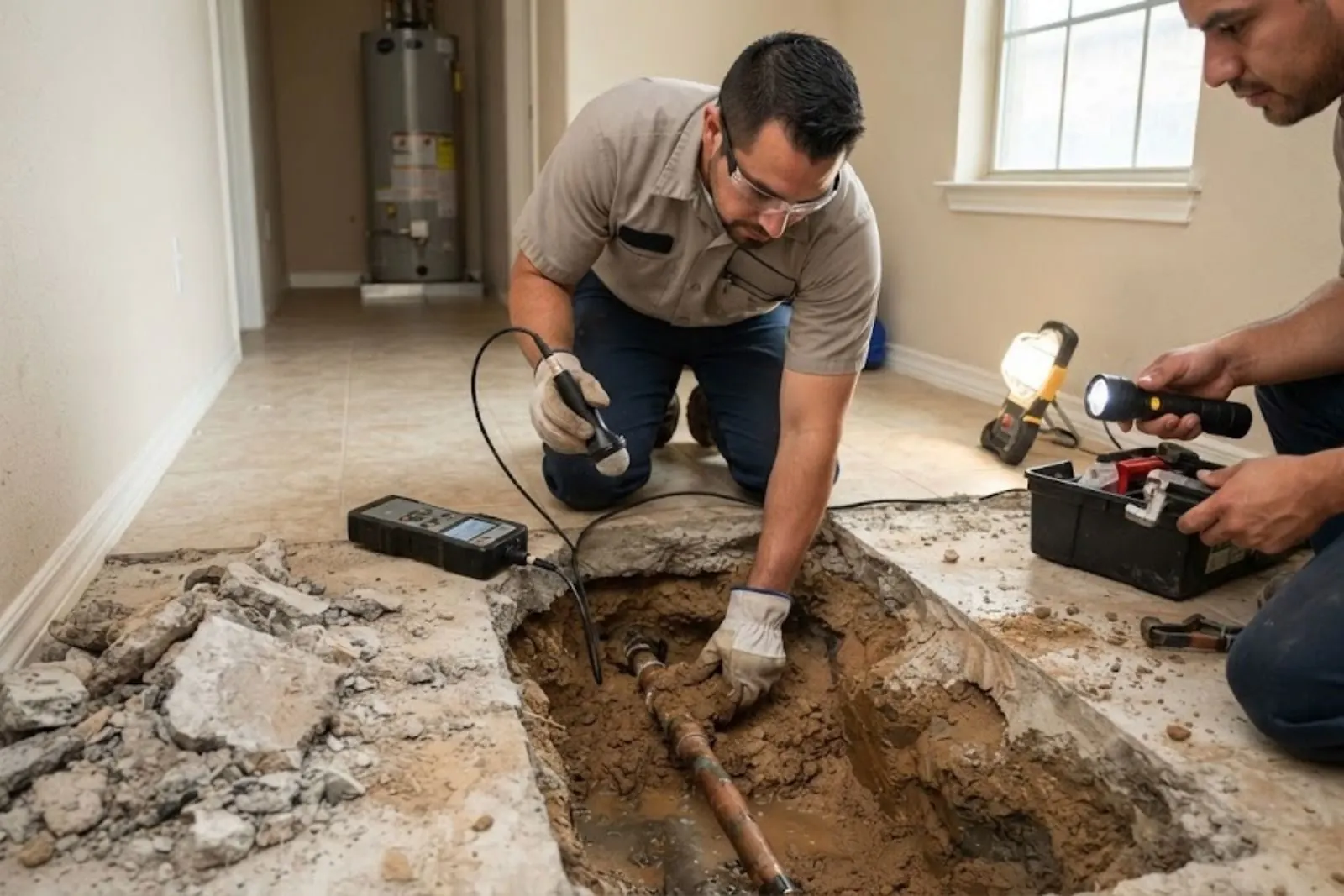
Slab foundations are common in central Florida, so a lot of homes here can have this problem. Check yours, since a house with a crawl space or raised floor has different options. This page covers the signs, the path from detection to repair, and the honest trade-offs between fixing one spot and replacing the lines.
Warm spot on the floor, running water you cannot see, or a bill that jumped
A slab leak hides in plain sight. The floor looks fine, yet something is wrong underneath, and the clues are physical. A leaking hot water line heats the concrete above it, so a bare foot finds a warm patch in tile or vinyl even when the heater is off.
The other signs are just as real. You may hear water running in the quiet of the night with every fixture closed. Baseboards swell, grout lines turn dark, flooring lifts at the seams, or a damp, musty smell comes up from carpet. A bill that rises over a few cycles with no change in use is the quietest signal of all.
- A warm or hot patch on the floor that does not match the sun or the vents.
- The sound of running water or a faint hiss with all taps closed.
- Water seeping up at a wall base, a door threshold or under flooring.
- A water meter that keeps moving with everything in the house off.
- Sudden low hot water pressure or a water heater that never seems to catch up.
How a slab leak goes from suspicion to proof
Nobody should break concrete on a hunch. We confirm the leak first, then pin down the exact spot, then talk through the repair.
- We start with the meter test. Close every fixture, watch the low-flow indicator, then close the main valve at the house and see if the dial stops.
- We isolate hot from cold by testing each line separately, since the warm floor spot usually points to the hot side.
- A pressure test on the isolated line tells us whether it holds. A drop means a leak is on that run.
- Acoustic listening gear on the floor picks up the hiss of escaping water, and thermal imaging maps the warm area.
- Once the spot is marked, we explain what the options are and what each one opens up in your floors.
When water is coming up through your floor: what to do first
Call at once if you see water rising through flooring, hear a steady rush, or smell something wet near the electrical panel. A line under a slab runs at normal house pressure, so the flow does not stop on its own.
These steps are safe for most homeowners to do while waiting.
- Turn off the main shutoff valve at the meter side of the house or where the line enters.
- Switch off breakers to any room with wet floors, and do not stand in water near outlets.
- Open a faucet at the lowest point in the house to bleed pressure out of the lines.
- Lift rugs and move furniture off wet flooring so you can photograph the damage and begin drying.
- Call (407) 964-8940 and tell us which room has the warm spot or the water.
Why pipes fail beneath a slab
Concrete is rigid and the ground under it is not. Soil shifts, tree roots push, and the slab itself can crack. Any of that can strain a line, especially at joints and bends.
Water chemistry and age also matter. Copper can develop pinholes from the inside, and a line that rubs against rough concrete or a rock in the fill can wear through slowly over years. High pressure speeds the process, which is one reason a pressure check is part of the visit.
We cannot tell you what material your house uses without looking, and we will not guess at it. The county property appraiser shows when your home was built, and that gives a rough idea of the plumbing era.
Your options: spot repair, reroute or repipe
This is the decision most people want help with. Each path has real upsides and real costs, and the right one depends on the line, the leak count and your plans for the house.
| Option | What happens | Best when | Trade-off |
|---|---|---|---|
| Spot repair | Cut and break the slab at the leak, replace the bad section | One leak, line otherwise sound | Floor opened, may fail again elsewhere |
| Reroute | Abandon the slab line, run a new one through walls or attic | Line is hard to reach or failing | Walls are opened, drywall needs patching |
| Repipe | Replace the whole run or the whole house with new pipe | Multiple leaks or old pipe | Largest job, most disruption, longest fix |
| Epoxy lining | Coat the inside of the pipe to seal pinholes | Small leaks, accessible ends | Not right for every pipe or damage type |
The honest trade-offs
A spot repair costs less and finishes faster, but it does not touch the rest of the line. If the pipe has failed once because of age or water chemistry, other spots may follow. A second leak a year later is a frustrating way to find that out.
A reroute moves the line out of the concrete, so the next leak is a wall repair instead of a floor demolition. The price is opened drywall and a new route that has to look decent.
A whole-house repipe settles the question for most of the system, but it is the biggest job. We would rather lay out the pros and cons and let you choose than push the largest option. If the leak is the only one and the pipe is otherwise healthy, a spot repair is often the sensible start.
What the work does to your home
Expect real disruption, and plan for it. We tell you where we will cut before work starts.
Floors
Tile, wood and carpet over the leak will be lifted or cut, and matching new material can be hard to find.
Water service
The line is shut off during the repair, and hot or cold may be off for part of a day.
Moisture
A leak that soaked the slab needs drying, and drywall or baseboards at the edge may need replacing.
Dust and noise
Breaking concrete is loud and dusty, so we contain the area and clear a path.
Finding the leak before it is a repair job
If you only suspect a slab leak, start with detection. Our leak detection service handles the meter test, pressure test and listening work, and that proof is also what an insurer usually asks to see. You can then decide with facts.
For homes in nearby towns, we also serve Oviedo, where much of the growth came after 1980. That is a hint, not a diagnosis, because each house needs its own check. If the leak is in the yard line rather than the floor, see water line repair.
What drives the cost of a slab leak repair
You get a clear price before work starts. These are the factors that move it.
Repair path
A spot repair, reroute and repipe are very different jobs, so each carries a different scale of labor.
Where the leak sits
A leak under a kitchen island or tiled hallway means more to remove and rebuild.
Number of failures
One leak on a healthy line is a smaller job than several on an aging one.
Flooring and finishes
Stone, hardwood and built-ins add rework that plain concrete does not.
Permits and inspection
Permit rules vary, so ask the Casselberry Building Division, and we can work with the inspection steps.
Homeowners insurance usually covers sudden and accidental water damage, such as ruined flooring, but typically not the failed pipe, gradual leaks or wear. Slab leaks are often treated as a gray area, so read your policy and ask your insurer before work begins.
Frequently asked questions
Yes. Our 24/7 emergency line is open every day, and we offer same-day appointments when available. We do not promise an arrival time, and we will walk you through shutting off the main and protecting wet areas first.
Warm floor spots, running-water sounds with the taps off, and a meter that moves with the main valve open are common clues. Only a meter test and a pressure test can confirm it. Many other issues, such as a toilet seal, mimic these signs.
For a spot repair, yes, in a small area. A reroute avoids the slab but opens walls or the attic. Which one is better depends on the line and the leak count.
Often it covers resulting water damage if the event was sudden, but not the pipe itself or slow leaks. Policies differ, so ask your insurer before repairs and keep photos, bills and any detection report.
Slab foundations are common in central Florida, but not every home has one. Look for a raised crawl space vent or ask the county property appraiser. If you are unsure, we can tell you on a visit.
Often yes. A single leak on an otherwise good line can be spot repaired, and a failing run can be rerouted. A full repipe makes sense when leaks keep coming back.
Still not sure which answer fits? Describe it to a licensed plumber.
Call (407) 964-8940Standards and sources
Slab repairs and reroutes fall under the Florida Building Code, Plumbing (8th Edition, 2023), and permit rules vary, so ask the City of Casselberry Building Division. Your homeowners policy decides what is covered. MyFloridaLicense.com verifies a plumber's license.