
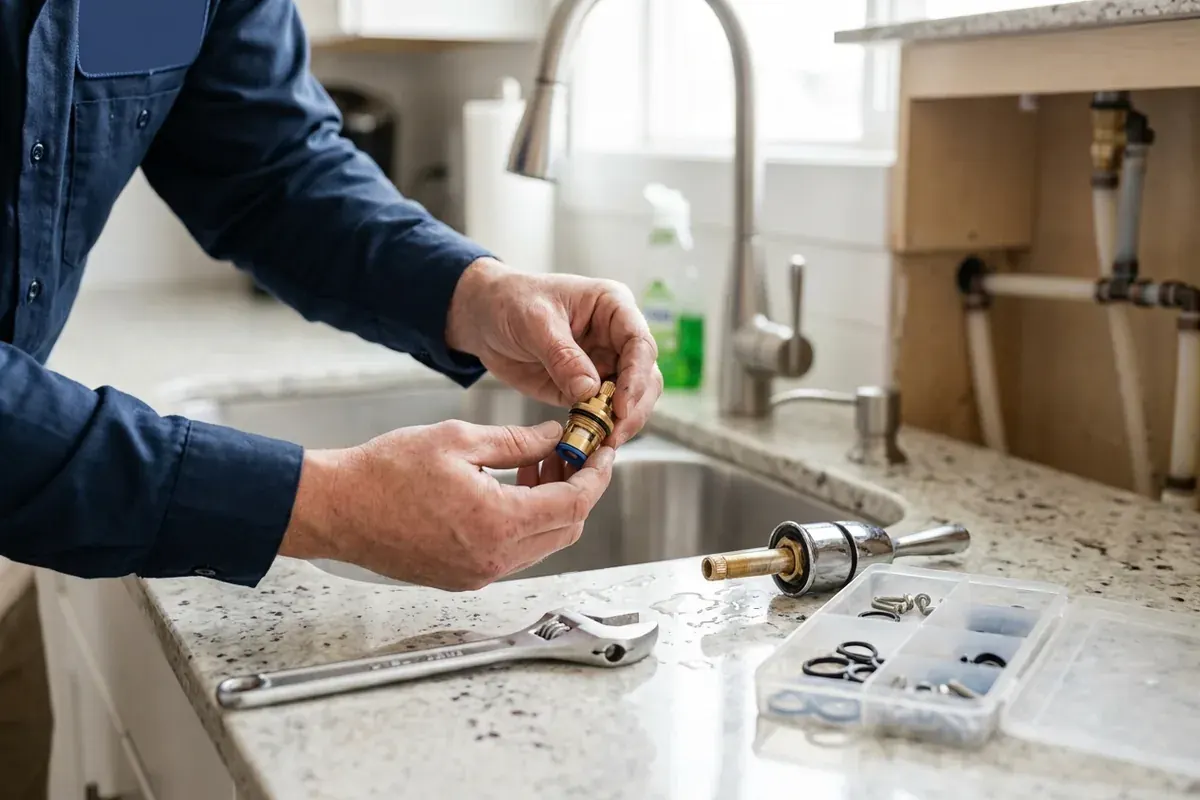
While you wait, find the nearest shutoff. Under a sink it is the small oval-handled angle stop on the wall. If it will not close, the next move is the main house valve, usually near the water meter or where the line enters the house.
A valve that will not shut off
Old stop valves seize. Mineral crust builds on the stem, the packing dries out, and years of sitting in one position make the handle stubborn. Forcing it can snap the stem or start a leak at the packing nut.
Turn it only gently, and if it does not move, leave it alone and go to the main house valve. The main is usually a gate valve with a round wheel or a ball valve with a lever. Quarter-turn ball valves are far less likely to stick than old multi-turn gate valves.
A valve that will not close is also the reason a simple faucet job turns into a bigger visit. We replace the failed angle stop first, so the fixture can be isolated for good.
When a supply line is spraying under the sink
Braided supply lines wear from the inside, and the first sign is often a sudden burst at the crimped end. Water pressure in a house is commonly 40 to 80 psi, which is plenty to soak a cabinet in minutes.
- Close the angle stop on the wall or floor under the sink by turning the handle clockwise.
- If it will not move, shut the main house valve at the meter box or where the line enters the house.
- Open the faucet above to relieve pressure, then catch drips in a bucket or towel.
- Move anything valuable out of the cabinet and mop up standing water on the cabinet floor and the room floor.
- Take a quick photo of the damage if you plan to file an insurance claim.
- Call (407) 964-8940 and we will tell you whether this is a quick line swap or something deeper.
Cartridge, ball, disc or compression: what is inside your faucet
Faucets leak for different reasons depending on how they seal. Knowing the type tells us which part to bring.
Cartridge
A cylinder that slides or rotates inside the body. Most single-handle faucets use one, and a worn O-ring or cartridge is the usual drip.
Ball
A single lever on a slotted ball with rubber seats and springs. Prone to drips at the base from worn seats.
Ceramic disc
Two ceramic plates that slide against each other. Very durable, but sediment can scratch them and cause a leak.
Compression
Two handles with rubber washers that press on a seat. A worn washer is the classic drip and an easy repair.
Fix the faucet or replace it
A repair kit costs less than a new faucet, but a pitted or corroded fixture is worth replacing. Here is how we weigh it.
| Symptom | Likely cause | Usual fix |
|---|---|---|
| Drip from the spout | Worn cartridge, seat or washer | Replace the cartridge or seat |
| Water at the handle base | Failed O-ring or packing | Replace seals |
| Low flow from one faucet | Clogged aerator or cartridge | Clean or replace |
| Wet cabinet floor | Supply line or angle stop | Replace line or stop |
| Pitted, flaking finish | Age and wear | Replace the faucet |
| Handle stiff or spins | Seized stem or stripped screw | Repair or replace |
Shower valve, showerhead and bathtub faucet problems
A shower that goes scalding or ice cold when someone flushes a toilet is often a worn pressure-balancing cartridge. A showerhead that sprays sideways is usually mineral buildup, which a vinegar soak can clear. Check yours before replacing.
A tub spout that drips after you turn the water off, or a diverter that sends water to the tub when the shower is on, usually means a worn diverter or valve seat. These repairs happen behind the wall tile, so we plan an access point before we start.
If you are also seeing a stain on the ceiling below a bathroom, that is a leak that may start in the shower valve. Our leak detection work can pin it down without tearing out a wall first.
Slow shower or tub drain
Hair and soap wrap around the stopper or the first few inches of the drain. A drain snake or a plastic hair-catching strip can clear it. Skip the harsh liquid drain openers, which can sit in the pipe and harm the fittings.
If a shower drains slowly and a nearby sink gurgles, the blockage is probably farther down the branch line. That is a job for drain cleaning rather than a faucet repair.
Replacing the angle stop and under-sink lines
The angle stop is the small valve that feeds each faucet. They are cheap parts that cause costly floods when they fail, and the supply lines connecting them to the faucet are no better.
On a replacement visit we swap the stop to a quarter-turn type, install new braided stainless lines sized to the faucet, and check the compression fittings for seepage. A good swap lasts, and a faucet that can be isolated is a faucet you can service without shutting the house down.
Casselberry's housing probably skews to the 1960s through 1980s, so original stops under older sinks are common. Check yours, and replace any that weep or will not turn.
What decides the price of a faucet or sink repair
A quick O-ring change and a valve replacement behind a tile wall are different jobs. We quote a clear price before work starts.
Fixture type
Kitchen pull-down, bathroom widespread and tub-shower valves each use different parts and take different time.
Repair or replace
A cartridge swap is small. A new faucet adds the fixture itself and sealing at the countertop or sink deck.
Access
A shower valve behind a tiled wall needs an access cut, and sink cabinets full of stored items take longer.
State of the shutoff
If the angle stop is seized, replacing it comes first, and that adds to the visit.
Time of the call
A night emergency through the 24/7 line is not priced like a same-day appointment when available.
Homeowners insurance usually covers sudden and accidental damage like a burst supply line, but typically not the failed part or gradual leaks and wear. Check your policy.
Frequently asked questions
Yes. The 24/7 line runs at night and on weekends, and we offer same-day appointments when available. We do not promise an arrival time, but we help you contain the water first.
A worn cartridge, seat or washer is letting water slip past the seal. The fix is replacing that part, not tightening the handle harder.
Yes, if water is flowing and the shutoff will not close. Turn off the main valve and call. A weep that you can contain with a bucket can wait for a same-day visit.
Many homeowners can swap a braided line if the angle stop closes fully. If the stop is stuck or corroded, stop and call, because forcing it can start a larger leak.
Look at the handles. Two handles often means compression or ceramic disc, and a single lever means cartridge, ball or disc. Taking a photo helps us arrive with the right part.
We do. Hair, grease and soap lodge in the trap and tailpiece, and we can clear those. Blockages farther down the line are covered by our drain work, and we also serve homes in Longwood and other nearby towns.
Still not sure which answer fits? Describe it to a licensed plumber.
Call (407) 964-8940Standards and sources
Faucet cartridges and supply lines should match the manufacturer's part numbers for your model. Fixture installation follows the Florida Building Code, Plumbing (8th Edition, 2023), and MyFloridaLicense.com lets you verify a license.