
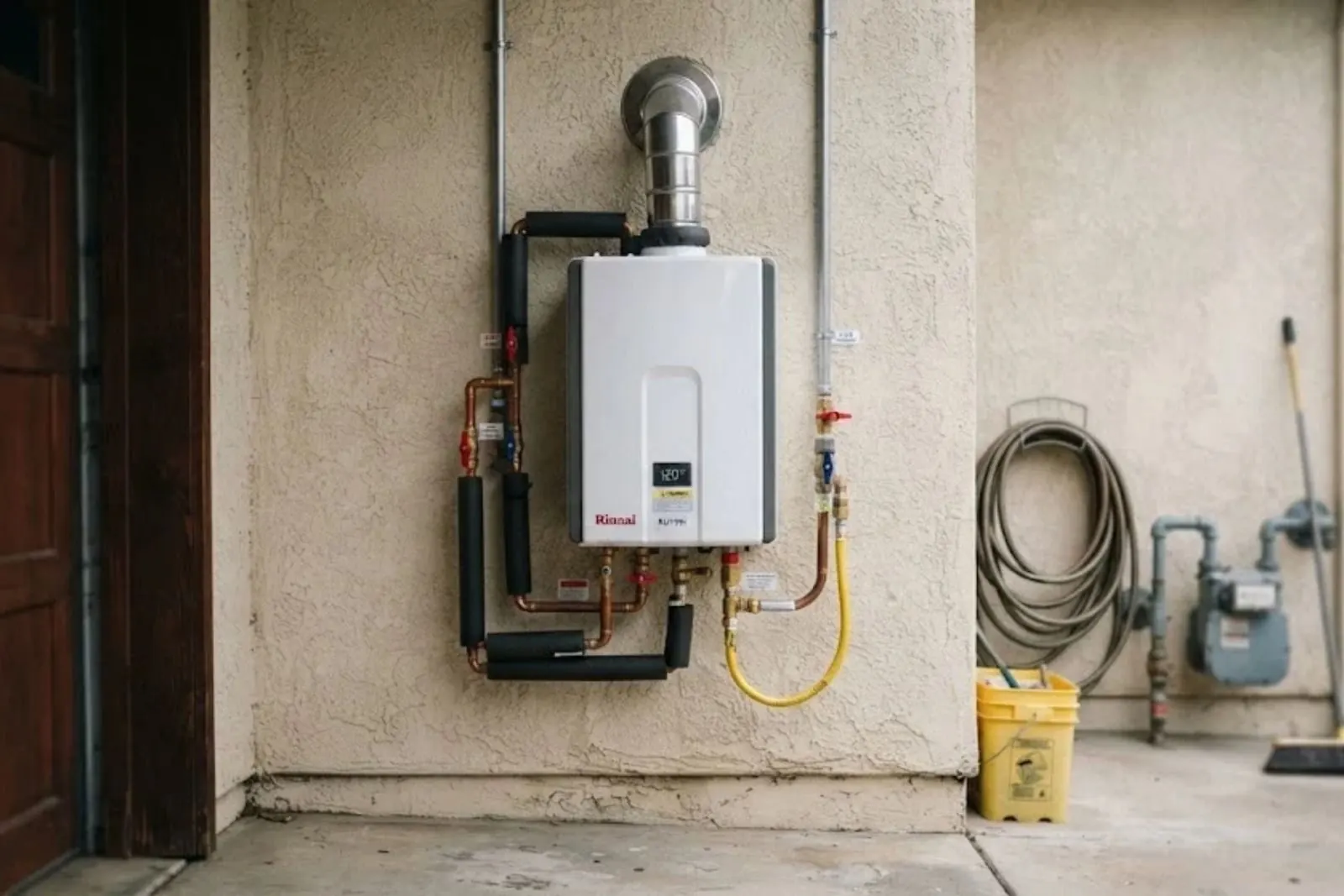
A gas tankless water heater needs a vent pipe that carries exhaust outdoors, and the right pipe depends on the unit. Condensing models run cooler exhaust through plastic pipe, usually PVC, CPVC, or polypropylene. Non-condensing models run hotter exhaust and need stainless steel venting. The manufacturer's installation manual names the allowed material, size, and maximum length.
That is why you cannot pick a vent pipe at the hardware store. This guide explains the main vent layouts, what decides the route, what happens to condensate, and why venting often decides how big an install gets. If you are comparing models first, see our tankless water heater service page.
Vent types compared
Names vary by maker, but nearly every tankless install falls into one of these layouts. Your manual picks the allowed ones.
| Layout | How it works | Best fit |
|---|---|---|
| Direct vent, two pipes | One pipe brings outside air in, one sends exhaust out | Closed rooms, sealed garages |
| Concentric vent | One fitting holds a pipe inside a pipe, intake outside and exhaust inside | Short wall runs with one penetration |
| Sidewall vent | Exhaust leaves through an exterior wall with a termination fitting | Most direct runs to an outside wall |
| Vertical roof vent | Exhaust rises through the roof with a cap | Interior locations with no usable wall |
| Power vent, indoor air | Unit draws room air, exhaust goes out | Open utility areas with enough air |
Why a tankless unit needs different venting than a tank
A standard tank heater vents hot, buoyant exhaust up a simple flue and relies on draft. A tankless unit burns far more fuel in short bursts, so it forces exhaust out with a fan and uses a smaller pipe. Many tank flues are the wrong size and material for a replacement tankless unit.
A tankless unit pulls a large volume of combustion air when it fires, often in a short burst at high demand. If air is short, the burner can run rough or shut down on an error code. The manual lists the minimum clearances, intake air needs, and the equivalent vent length allowed. Treat those numbers as law for that unit.
PVC, CPVC, polypropylene, or stainless: let the manual decide
Exhaust temperature sets the material. A condensing unit wrings extra heat out of the exhaust, so the gas leaving the vent is cool enough for approved plastic pipe. A non-condensing unit leaves hotter, and stainless venting built for that heat is required.
Never mix brands of vent pipe or substitute ordinary drain pipe, because the listed system is tested as a whole. Cement, primer, gaskets, and terminations are part of the listing. The vent diameter, usually two or three inches on residential units, also comes from the manual. Our crew follows the manufacturer's instructions and the Florida Building Code, Plumbing, and will say so on the quote.
How a vent route gets planned
A good installer walks the path before pricing it. This is the usual order of questions.
- Pick the unit's mounting spot, then measure the straight distance to the nearest allowed outside wall or roof.
- Count each elbow, because every bend adds equivalent length and the manual caps total length.
- Check the termination spot for clearances from windows, doors, soffit vents, meters, and other openings, as set by the manual and code.
- Plan a slight slope back toward the unit for condensing models, so condensate drains back instead of pooling.
- Run the condensate line to an approved drain and decide whether a neutralizer is needed.
- Seal and support each joint, then test combustion and look for leaks before leaving.
Condensate: the water that comes out of a condensing vent
A condensing tankless unit pulls so much heat from the exhaust that water vapor turns to liquid. That liquid is mildly acidic. The unit collects it and sends it out through a small drain line, often fitted with a neutralizer cartridge filled with limestone-type media.
That line must drain by gravity or through a small pump, and it must not freeze or kink. Dumping it onto a slab or into a garden bed is a poor idea. Ask the Casselberry Building Division how local drains may receive it, because rules vary and they decide, not a hardware store.
Why venting decides installation cost
Two houses can get the same tankless unit and end up with very different quotes. Most of the gap is the vent. These are the cost factors, in rough order of weight.
Length of the vent run
Longer runs need more pipe, more supports, and sometimes a larger diameter.
Number of elbows and wall or roof penetrations
Each bend and each hole cut through framing adds labor and sealing work.
Replacing an old flue
A tank water heater flue often cannot be reused, so removing or capping it adds work.
Condensate routing
Reaching a drain or adding a small pump changes the parts list.
Gas line and combustion air
A larger gas line or added air supply often comes with a tankless swap.
Homeowners insurance usually covers sudden and accidental damage, but typically not the failed part itself or gradual leaks and wear. Check your policy if a failed vent has caused damage.
Questions to ask before you sign for a tankless install
These questions keep the quote honest and the vent route visible before work starts.
- Which exact vent material and diameter does this model's manual require?
- How long is the planned run, and how many elbows does it include?
- Where will the termination sit, and what is near it?
- Where does the condensate go, and is a neutralizer included?
- What happens to the old tank flue?
- Will the install be permitted, and who pulls the permit?
Carbon monoxide: the safety issue behind all of this
Exhaust contains carbon monoxide. A loose joint, a blocked termination, or a wrong-material vent can push it into the house. Install a battery or plug-in CO alarm near the bedrooms and test it monthly.
If the unit throws repeated vent or exhaust error codes, shut it down and call. Do not reset it over and over. Our water heater installation team sets and tests vents to the manual, and we serve Oviedo and Longwood along with Casselberry.
Casselberry notes: older homes and the permit desk
Casselberry grew fastest in the 1960s and 1970s, which suggests that much of the housing stock likely dates from the 1960s to 1980s. Homes of that era often have a tank heater in a closet or garage with an old flue. That flue will not suit a tankless unit, so expect a new vent route and a wall or roof penetration. The county property appraiser record shows the actual build year of your home.
Permit rules vary, so ask the Casselberry Building Division at 95 Triplet Lake Drive, open Monday through Thursday, 7 a.m. to 6 p.m. Florida plumbers follow the Florida Building Code, Plumbing, 8th Edition (2023), along with the manufacturer's instructions. Contractors upload a state license, insurance proof, and a business tax receipt with each permit application, so ask to see yours.
Sources and standards used: City of Casselberry Building Division page, U.S. Census population records cited on the city fact sheet, Florida Building Code, Plumbing 8th Edition (2023) reference
Frequently asked questions
Usually not. Tankless units run hotter exhaust or wetter condensate than a tank flue was built for, and the pipe size is often wrong. The manual says what is allowed, and a mismatch is a safety risk.
A concentric vent puts the intake pipe inside the exhaust pipe, or the reverse, in one fitting. It needs only one hole through the wall or roof, which makes the outside look cleaner.
The manual sets the maximum equivalent length for each pipe size and counts each elbow as extra length. Your installer measures the planned run against that limit before the work begins.
That is the condensate drain. A condensing unit turns exhaust vapor into liquid, and that liquid must be piped to a proper drain, often through a neutralizer cartridge.
Permit rules vary, so ask the Casselberry Building Division before work starts. The division has an online portal, and a licensed contractor can submit the application with the required license and insurance documents.
Still not sure which answer fits? Describe it to a licensed plumber.
Call (407) 964-8940Plumbing help for this problem
Related services:
Nearby towns we serve: