
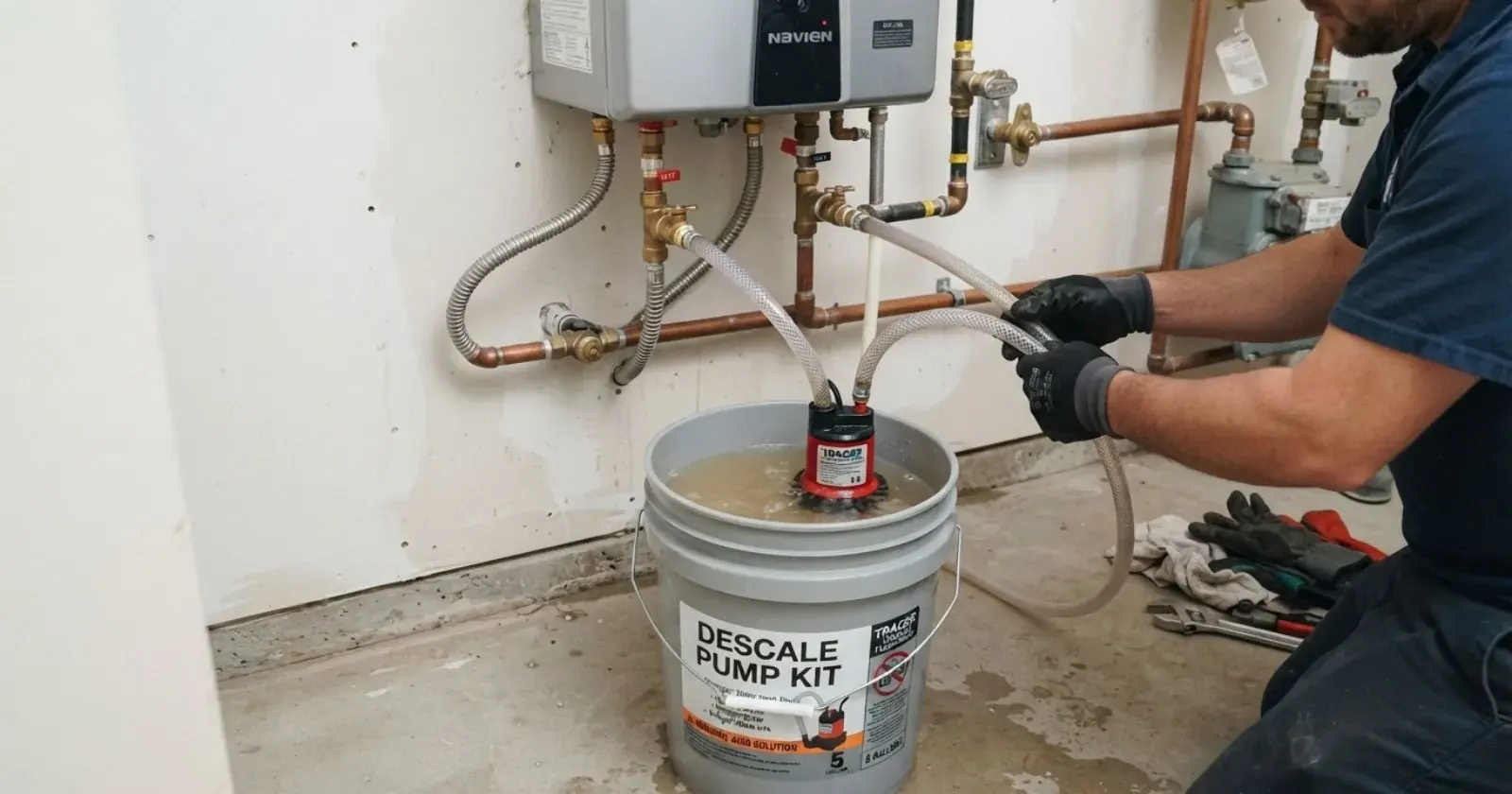
Most tankless water heater makers call for a service once a year. The visit includes a descaling flush of the heat exchanger, a cleaned inlet water filter screen, a check of the vent and condensate drain, and a review of the error code history. Homes with hard water, heavy use, or a recirculation loop may need it more often. The manual sets the exact interval for your model.
This guide covers what each part of the service does, a schedule table by household situation, and which jobs you can do yourself. It leaves out vent pipe types, which have their own guide. If your unit is already throwing codes, our tankless water heater service can diagnose it.
What an annual tankless service includes
A proper service follows a set order. Each step protects a part that scale, grit, or exhaust can damage.
- Shut off the power and the gas, then close the cold and hot isolation valves.
- Connect hoses to the service ports and run a descaling solution, usually food-grade white vinegar or a maker-approved cleaner, through the heat exchanger with a small pump.
- Circulate the solution for the time the manual states, often around forty-five minutes to an hour.
- Flush with clean water, then remove and rinse the cold water inlet screen.
- Inspect the vent, intake, and condensate drain for blockage, leaks, or loose joints.
- Reopen the valves, restore power and gas, run hot water, and check the outlet temperature and flow.
- Read the error code history and clear anything that has a pattern.
How often: a schedule by situation
Use this as a starting point and defer to your manual. Water quality, household size, and extra equipment all change the interval.
| Situation | Typical interval | Why |
|---|---|---|
| Small household, softened water | Once a year, per the manual | Little scale forms |
| Average household, untreated water | Once a year | Scale builds on the heat exchanger over time |
| Large household or heavy daily use | Every 6 to 12 months | More heating hours, more scale and wear |
| Recirculation loop installed | Per the manual, often more often | Continuous cycling adds wear |
| Vacation home or long absences | Before and after a long gap | Standing water and idle parts |
| Repeated error codes or low flow | Service now, then reset the schedule | Codes often point to scale or a clogged screen |
Why scale is the real enemy
A tankless unit heats water as it flows through a narrow heat exchanger. Dissolved minerals come out of hot water and cling to the metal as scale. That scale acts like insulation, so the unit works harder, flow drops, and the exchanger can overheat.
A thin layer is normal. A thick layer causes the error codes and the rumbling noise people call kettling. Descaling dissolves the layer before it reaches that point, and it is the single most valuable maintenance task on the machine.
Keep a simple log taped inside a cabinet or saved on your phone. Note the service date, the outlet temperature at full flow, and any code that appeared. A log turns a vague feeling that the water seems slower into a pattern a technician can read. It also tells you when a unit is drifting off its schedule, such as codes returning only a few months after a flush.
What you can do yourself between service visits
A few small jobs are fine for a careful homeowner. Do not open the gas side or the burner chamber.
- Wipe dust off the outside of the unit and keep the area clear of storage.
- Clean the cold water inlet screen if the manual shows a simple drain-and-rinse method.
- Look at the condensate line and neutralizer, if fitted, and watch for drips or blockage.
- Check the display for stored error codes and write them down with the date.
- Make sure the vent termination outdoors is free of leaves, nests, or debris.
- Test your carbon monoxide alarm monthly.
What water quality changes about maintenance
The more minerals in your water, the faster scale builds, and the more often the heat exchanger needs a flush. Water quality varies by supply and by home, so test your tap or ask your utility for its annual water quality report. Guesswork on this point costs money.
A water softener or conditioner can cut scale at the source and stretch the interval, though your maker's manual may still call for an annual service. A sediment prefilter also protects the inlet screen from grit. Our water softener and filtration team can talk through which treatment suits your water once you know what is in it.
Signs the unit needs service sooner
Watch for lukewarm water at full flow, hot water that cuts in and out, popping or rumbling noises, a display code that returns after reset, and a drop in flow at the fixtures. Any one of these suggests scale or a clogged screen.
Do not ignore a vent or exhaust code. Turn the unit off and call. Our crew also serves Fern Park and Winter Park, and a same-day appointment is possible when available.
What affects the cost of a tankless service visit
Costs vary because units and conditions vary. These are the factors that shape a service quote.
Whether isolation valves are installed
Units without service valves need them added before a flush, which adds time and parts.
Scale level
A heavily scaled exchanger may need a longer flush or repeated cycles.
Unit type and location
Attic, closet, or outdoor units differ in access and in work needed.
Recirculation pump or controls
Extra equipment adds items to check and maintain.
Repairs found during service
A worn sensor, igniter, or clogged condensate line is quoted separately from the flush itself.
Homeowners insurance usually covers sudden and accidental damage, but typically not the failed part itself or gradual leaks and wear. Routine maintenance is a homeowner expense, so check your policy.
Do it yourself or hire it out
| Task | Homeowner | Licensed plumber |
|---|---|---|
| Wipe down and clear the area | Yes | Not needed |
| Clean the inlet screen | Often, if the manual shows how | If you are unsure |
| Descaling flush | Possible with isolation valves and a pump | Best for first service or heavy scale |
| Vent and condensate check | Visual look only | Full inspection and repair |
| Gas line and burner work | No | Yes |
| Error code diagnosis | Note the code | Yes |
Casselberry notes: water supply and where to check
The City of Casselberry Utilities Department draws groundwater from Floridan Aquifer wells at the North Plant, South Plant, and Howell Park. It aerates to cut sulfur odor, disinfects with chlorine, and adds orthophosphate for corrosion control. The city report does not state a hardness figure, so test your tap or ask the City of Casselberry Utilities Department for its annual water quality report before choosing a service interval.
If you hire out, check the license first. Florida licenses contractors under Chapter 489, Florida Statutes, and you can verify any license at MyFloridaLicense.com using Verify a License, by number, individual name, or business name. Permit rules vary, so ask the Casselberry Building Division at 95 Triplet Lake Drive if repair work goes beyond routine service.
Sources and standards used: City of Casselberry 2025 Consumer Confidence Report, City of Casselberry Utilities Department information, Florida DBPR MyFloridaLicense.com licensing guidance, City of Casselberry Building Division page
Frequently asked questions
A full descaling flush typically takes about an hour once the hoses are set up, though the manual states the circulation time. Scaled units may need longer.
Many makers allow food-grade white vinegar, and some require their own solution. Follow your manual, because the wrong cleaner can harm seals or the exchanger.
Scale builds up, flow drops, and the unit starts throwing error codes. Over time the heat exchanger can fail early. Check your manual too, since makers often list the service they expect.
Not always. It depends on your water and your maker's rules. Test your tap first, then decide whether treatment saves enough on maintenance to be worth it.
Ask the City of Casselberry Utilities Department for its annual water quality report, then test your tap at home. The city report does not give a hardness figure, so a home test tells you more about scale risk in your own unit.
Still not sure which answer fits? Describe it to a licensed plumber.
Call (407) 964-8940Plumbing help for this problem
Related services:
Nearby towns we serve: