
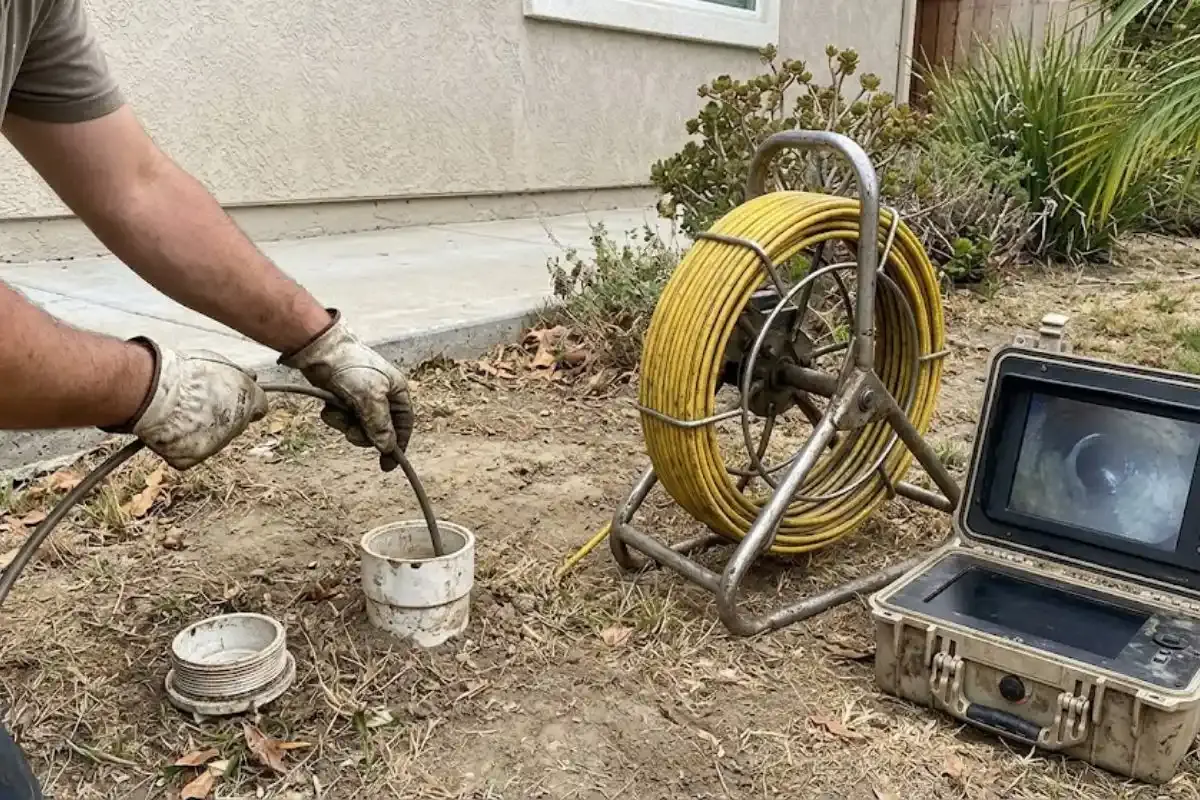
Yes, a sewer line camera inspection before you buy a house in Casselberry, FL is worth ordering, especially for a home built decades ago. A standard home inspection does not look inside the buried line. A camera on a flexible rod, the core of a sewer inspection, travels from a cleanout toward the street and records cracks, roots, bellies, offsets and collapsed sections.
The report gives you facts to use before closing. This guide covers what the camera finds, how it fits into an inspection period, how to read the footage and the report, and what a camera cannot tell you.
What a camera inspection finds and why it matters to a buyer
The camera shows the inside of the pipe. Each defect type points to a different kind of repair, and some are cheap while others are major.
| Defect | What you see | What it means for the buyer |
|---|---|---|
| Root intrusion | Fine hairs or thick masses entering at joints | Cleaning now, joint repair or lining later |
| Belly (sag) | A low spot holding standing water | Solids settle, repeat clogs likely |
| Offset joint | Pipe ends misaligned, with a lip | Catches debris, roots enter at the gap |
| Crack or break | A line or a missing section of pipe wall | Leak into soil, possible collapse |
| Scale or grease | Rough buildup on the wall | Narrowed pipe, usually cleanable |
| Bad connection | Poor tie-in at the main or a cleanout | Local repair at the junction |
Pipe material and age: what to expect by era
Sewer pipe materials changed over the decades. Clay tile was common in older homes, cast iron appeared in many mid-century homes, and a fiber conduit called Orangeburg was used for a stretch in the middle of the century. PVC replaced them in newer construction.
Each material fails in its own way. Clay cracks and lets roots in at joints, cast iron rusts and scales from the inside, and Orangeburg can flatten or deform over time. PVC is smooth and tough but can still shift or settle. The camera shows what you actually have, so you are not guessing from the year on the deed.
How the inspection fits into your inspection period
Contracts differ, and your agent or attorney should confirm the dates. The pattern below is general.
- Ask your agent how long your inspection period runs and whether the contract allows a sewer scope.
- Book the camera early, since inspectors and plumbers fill up and results can take a day or two to review.
- Ask the seller for access to the cleanout, or find the cleanout outside the house with the seller's permission.
- Have the plumber record the full run from the house to the street or tank, with distance marks on the video.
- Get the written report and the footage the same day, so you have time to ask follow-up questions.
- Decide before the period ends what to ask the seller for, using the findings.
How to read a sewer camera report
- Check that the report states the starting point, the direction and the total length scanned.
- Look for footage markers: a distance counter, depth and a clear picture at each defect.
- Note whether the line was cleaned first. A dirty line hides defects.
- Read how the report rates each defect: minor, moderate or severe, and whether it is urgent.
- Make sure it includes a sketch or map showing where each problem sits along the line.
- Ask what the camera could not reach, such as a blocked section or a point where the line turned.
Using the report in negotiation
A clean report is worth knowing. A report with roots or a belly gives you a basis to ask for a repair, a credit toward repair, or a price change. Get a repair quote from a licensed plumber so your ask rests on the work needed, not a guess. Sewer line repair can range from a spot fix to a full replacement, and the quote tells you which.
Hedges, trees and roots: what the yard tells you
Roots seek moisture and nutrients, and an open joint in a sewer line gives them both. Large trees and hedges near the line raise the chance of intrusion, even if the house looks fine. A big oak or a row of thirsty shrubs between the house and the street is a reason to ask for the camera.
A camera shows the roots that are in the pipe now, and a good operator pauses on each patch so you can judge the size. It does not tell you how fast they will grow back. A line that is clean today may clog again in a year if the joints are open.
Routine finding or deal-changer?
Not every defect should scare you off a house. This table sorts common findings by how much weight to give them while the inspection period is running.
| Finding | Usually routine | Worth a negotiation |
|---|---|---|
| Light root hairs at one joint | Yes, if the line is otherwise sound | No, unless it repeats along the run |
| Grease and scale | Yes, cleaning clears it | Only if the pipe is narrowed badly |
| Single offset joint | Sometimes | Yes, if it holds water or catches debris |
| Long belly with standing water | No | Yes, it may need a section replaced |
| Cracked or broken pipe | No | Yes, get a repair quote first |
| Collapsed section or missing pipe | No | Yes, and consider a second opinion |
What a camera cannot tell you
A camera sees the inside of the pipe, not the soil around it. It cannot measure how stable the ground is, and it cannot always see a crack that is tight and dry. If the line is full of water or silt, the view may be blocked.
Cameras also have a reach. A standard push camera can follow about 100 to 200 feet. If the line is long, shared with a neighbor or goes into a tank, the report may stop short. A locator can mark where the camera head sits, which helps you map the line to the lot.
What drives the cost of a pre-purchase sewer scope
Plumbers price scopes by the work required. These factors move the quote.
Cleanout access
A clear outdoor cleanout is quick. No cleanout means pulling a toilet or cutting in an access point.
Line length and layout
A long run, multiple bends and a connection to a septic tank or a city main add time.
Cleaning before the scan
A heavily soiled line needs a cleaning pass so the camera can see the wall.
Locating and mapping
Marking depth and position with a locator adds equipment and time.
Report detail
A written report with video, notes and a defect map takes more time than a verbal summary.
Homeowners insurance usually covers sudden and accidental damage, but typically not a worn sewer pipe or gradual leaks and wear. Check your policy. We give a clear price before work starts.
Casselberry notes: housing age and checking the plumber
Casselberry grew from 2,463 people in 1960 to 15,037 in 1980, so much of the housing likely dates from the 1960s to the 1980s. The Seminole County property appraiser record shows the actual build year for any one house, so look it up before you book the scope. An older home deserves a closer look at the line.
Before you hire anyone, verify the license at MyFloridaLicense.com using Verify a License, and search both the business name and the individual qualifier. If a repair follows, ask the Casselberry Building Division whether a permit applies, since permit rules vary.
Sources and standards used: US Census population figures cited by the City of Casselberry, Seminole County Property Appraiser (general), Florida DBPR MyFloridaLicense.com, City of Casselberry Building Division page
Frequently asked questions
Usually not. A home inspector checks visible plumbing, fixtures and drainage at the house. The buried line from the house to the street needs a camera scope by a plumber or a specialist.
The buyer often orders and pays for it during the inspection period, though contracts vary. Ask your agent or attorney. The results can then be used in negotiation.
Not well. High water or silt blocks the lens. A plumber may clean the line first, or note the blocked section in the report as unseen.
The process is the same, but the local rules differ. Winter Park is in Orange County, so its building department and utility are not Casselberry's. See our Longwood and Winter Park pages for details.
Check yours. The City of Casselberry Utilities Department can tell you how an address is served, and the answer changes what the camera should cover. A septic tank setup means the scope runs to the tank, not the street.
Still not sure which answer fits? Describe it to a licensed plumber.
Call (407) 964-8940Plumbing help for this problem
Related services:
Nearby towns we serve: