
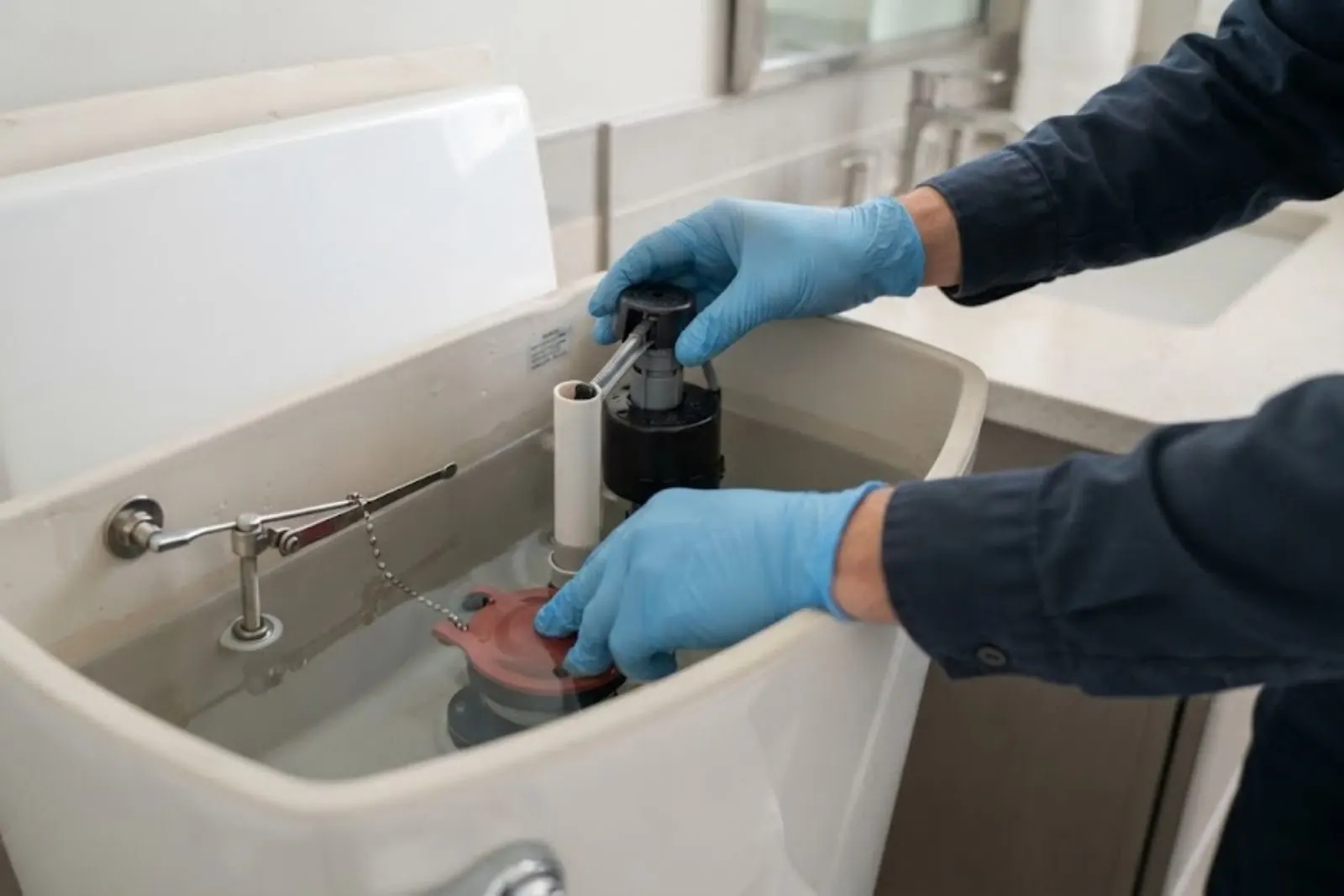
Most toilet repairs come down to five parts: the flapper, the fill valve, the flush handle chain, the wax ring, and the closet bolts. To repair a toilet, match what it does to the table below, shut off the water at the small valve on the wall, and replace the worn part. Many fixes take under thirty minutes with a screwdriver and a pair of pliers.
The skill is in diagnosis. A toilet that runs, one that flushes weakly, and one that leaks at the floor are three different problems with three different parts. This guide walks through each, tells you what to buy, and says where a do-it-yourself fix ends. If a stubborn problem remains, our toilet repair service covers it.
Diagnose by symptom first
Start here. Lift the tank lid, watch what happens during a flush, and pick the closest row.
| Symptom | Likely cause | Fix |
|---|---|---|
| Runs or hisses after the flush | Worn flapper or tangled chain | Replace flapper, adjust chain |
| Water level too high, spills into overflow tube | Fill valve not shutting off | Adjust float or replace fill valve |
| Weak flush | Clogged rim jets or low tank water | Clear the jets, raise the water level |
| Rocks when you sit | Loose closet bolts or uneven floor | Tighten bolts, add shims |
| Water at the base | Failed wax ring or loose bolts | Reset the toilet with a new wax ring |
| Slow to refill | Clogged fill valve or partly closed stop valve | Open the valve, clean or replace the fill valve |
Toilet runs after flushing: replace the flapper
A running toilet wastes water around the clock, and the flapper is the usual cause. It is the rubber seal at the bottom of the tank that lifts when you flush and drops to stop the flow. Rubber hardens or warps with age, and a leak past it makes the fill valve refill the tank over and over.
- Close the shutoff valve behind the toilet by turning it clockwise, then flush to empty the tank.
- Unhook the chain and slip the old flapper ears off the overflow tube pegs.
- Compare the old flapper to the new one, since two-inch and three-inch flush valves need different sizes.
- Clip the new flapper onto the pegs and hook the chain with about half an inch of slack.
- Open the shutoff valve and let the tank fill, then flush twice and watch the seal.
- Drop a few drops of food coloring into the tank, wait fifteen minutes, and check the bowl for color, which shows a leak.
Water keeps filling or the tank overfills: the fill valve
The fill valve is the tall assembly on the left side of the tank that lets water in. If water flows up the overflow tube and never stops, the float is set too high or the valve has failed. Lower the float by turning the adjuster screw or sliding the clip down the rod.
If the valve keeps hissing after an adjustment, replace it. A universal fill valve costs little, fits most tanks, and installs with a nut under the tank and a supply line on the shank. The water level should stop about one inch below the top of the overflow tube.
A weak flush that leaves the bowl dirty
Weak flushes have three common causes. The tank water level may be set low, the rim jets under the bowl lip may be clogged with mineral buildup, or a partial clog sits in the trap. Start with the water level and a short test flush.
To clear the jets, pour a cup of vinegar into the overflow tube, wait an hour, and flush. Use a bent wire or small brush on the holes under the rim. If a plunger brings water down slowly, the clog sits deeper, and a closet auger or a drain machine is the next step. A repeat clog is a job for our drain cleaning crew.
Toilet rocks or leaks at the base: reset with a new wax ring
A wobble means the closet bolts are loose or the floor flange is uneven. A pool of water at the base after a flush means the wax ring is no longer sealing. Rocking breaks the wax seal, so fix the wobble first.
- Shut off the water, flush, and sponge out the tank and bowl.
- Disconnect the supply line from the shutoff valve and remove the closet bolt caps and nuts.
- Lift the toilet straight up and set it on newspaper or a towel.
- Scrape the old wax from the flange and the toilet horn, and check the flange for cracks or rust.
- Press a new wax ring onto the horn, or set a wax-free seal on the flange.
- Lower the toilet squarely onto the bolts, press down, and tighten the nuts alternately a little at a time.
- Reconnect the supply, turn on the water, flush a few times, and check around the base.
Parts and tools to have on hand
Buy parts to match your tank, not to match a guess. Take a photo of the old part or bring it to the store.
- A flapper sized for a two-inch or three-inch flush valve.
- A universal fill valve with an adjustable height.
- A wax ring and new closet bolts if the old ones are rusted.
- Plastic shims for an uneven floor.
- A new braided supply line if the old one is stiff or kinked.
- Adjustable pliers, a screwdriver, a sponge, and a bucket.
What affects the cost of a toilet repair visit
A flapper swap and a floor-level reset are very different jobs. These are the factors that set the cost.
Which part is failing
A flapper or fill valve is a small parts-and-labor job, while a wax ring reset takes more time.
Damage beneath the toilet
A slow leak may have softened the subfloor, and a cracked or rusted flange needs its own repair.
Age and condition of the toilet
A cracked tank or a bowl with a failing glaze may not be worth fixing.
Shutoff valve and supply line
A stop valve that will not close often needs replacing before anything else.
Clog depth
A clog beyond the toilet trap may need machine work on the drain line.
Homeowners insurance usually covers sudden and accidental damage, but typically not the failed part itself or gradual leaks and wear. Check your policy if a leak has damaged the floor.
When to stop and call a plumber
Stop if the floor around the toilet feels soft, if the flange is cracked, or if a toilet overflows repeatedly with a plunger in your hand. A soft floor means water has been getting in for a while. A repeat overflow means the problem sits further down the line.
Also call if more than one drain in the house backs up. Our crew reaches Longwood and Fern Park as well as Casselberry, with same-day appointments when available.
Casselberry notes: chlorine, the tank, and old rubber
The City of Casselberry disinfects its water with chlorine, drawn from Floridan Aquifer wells at the North Plant, South Plant, and Howell Park. Chlorine is a normal part of safe tap water, and over years it can break down rubber parts like flappers. A flapper that goes soft or sticky in a few years is common, so replace it before it starts leaking.
Drain layouts and fixture ages vary from house to house. Permit rules vary, so ask the Casselberry Building Division at 95 Triplet Lake Drive if you plan to move a toilet or change the drain. If the building is a rental or HOA home, confirm who handles repairs before you start.
Sources and standards used: City of Casselberry 2025 Consumer Confidence Report, City of Casselberry Building Division page
Frequently asked questions
Add a few drops of food coloring to the tank and wait fifteen minutes without flushing. If color shows in the bowl, the flapper is leaking.
A tiny leak past the flapper slowly lowers the tank level, so the fill valve kicks in. Replace the flapper and check the chain for slack.
It will not help a weak flush, because the cause is low water level or clogged rim jets. Check the tank water level, then clean the jets.
It can be. Rocking breaks the wax seal and lets sewage water leak onto the subfloor, which can rot the wood. Tighten the bolts gently, and replace the wax ring if the base has leaked.
The city uses chlorine to disinfect its water, and chlorine can age rubber over time. We cannot say how fast it happens in any one house. Check your flapper every few years and replace it if it feels soft, sticky, or warped.
Still not sure which answer fits? Describe it to a licensed plumber.
Call (407) 964-8940Plumbing help for this problem
Related services:
Nearby towns we serve: