
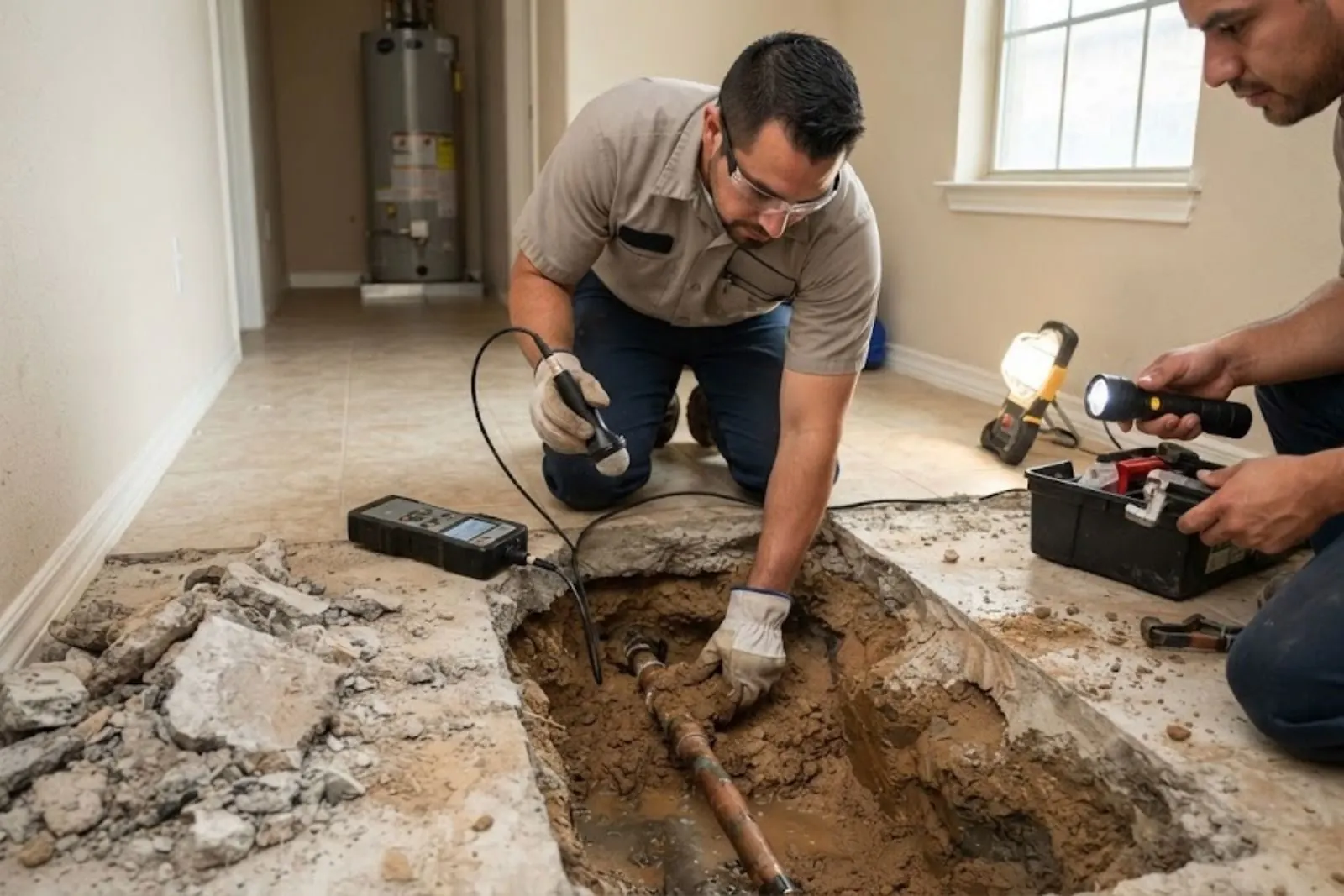
No honest article can give you one price for a hot water slab leak repair. The cost turns on six things. They are how the pipe is reached, how deep it sits, which repair method fits, what flooring covers it, how many leaks there are, and whether the fix is a patch or a reroute. A plumber can only quote after the leak is located.
This guide explains each factor in order of weight, why hot lines under slabs fail more often than cold ones, and how insurance usually treats the bill. It is about cost, not about finding the leak. If you suspect a leak but have not confirmed one, start with our leak detection service and come back.
The cost factors, ranked by how much they move the bill
Use this table to see what a quote is made of. The wider the gap between the two ends, the more questions you should ask.
| Factor | Lower-cost end | Higher-cost end |
|---|---|---|
| Access | Leak under a bare slab near a wall | Leak under a kitchen island or bath |
| Depth and slab thickness | Shallow pipe, easy cut | Deep line, thick or reinforced slab |
| Repair method | Spot repair at one point | Reroute through walls or attic |
| Flooring above | Tile that can be lifted whole | Hardwood or glued tile over the spot |
| Number of leaks | One confirmed leak | Several pinholes along old pipe |
| Hot or cold line | Cold supply | Hot line, often more worn |
| Water damage | Caught early, dry slab | Wet subfloor, mold, or soaked walls |
Why hot lines under a slab fail more often than cold ones
Hot water runs at a higher temperature than cold, and heat speeds up the chemistry that eats copper from inside. A hot line also expands and contracts every time the heater cycles, and that movement rubs the pipe against the concrete. Over many years a rub point can wear a pinhole through the wall.
Fast-moving water adds to the wear. Pinholes tend to show up at elbows and tight bends, where the flow hits the pipe wall hard. If one hot line has failed once, the rest of that run is the same age and has had the same life, so a second leak is a real possibility.
Meter still running or a warm spot on the floor: signs worth acting on
Slab leaks announce themselves quietly. A water meter that keeps moving when every fixture is off is the most telling sign. A water bill creeping up with no change in use is another, and so is a warm patch on the floor, the sound of running water in silence, or a hot water heater that runs more than usual.
If you see these, shut off the main valve and confirm the meter stops. A hot line leak under the slab is wasting heated water, which drives the electric or gas bill too. Prompt action keeps the damage, and the bill, smaller. Our slab leak repair service can walk through next steps.
Repair, reroute, or repipe: how the choice changes the cost
There are three ways to solve a slab leak. The right one depends on how many leaks, how old the pipe is, and how much floor you can stand to open.
| Approach | What it involves | Best fit |
|---|---|---|
| Spot repair through the slab | Cut the concrete, expose the pipe, fix the leak, patch the slab | One leak, good surrounding pipe |
| Reroute above the slab | Abandon the leaking line and run new pipe through walls or attic | Hard-to-reach leak or repeat leaks |
| Repipe the affected zone | Replace the whole hot line or all supply lines | Several leaks or aging pipe |
| Epoxy or lining method | Coat the inside of the pipe in place | Some pipe conditions only, per the maker |
What a slab leak quote should spell out
Before you agree to the work, ask for each of these in writing. A clear price before work starts means you know what is in and out.
Leak location confirmation
The plumber should show how and where the leak was found, since the cut location follows from it.
Concrete and flooring work
Who cuts, who patches, and who restores flooring over the spot are separate lines in the quote.
Pipe and method
Copper, PEX, or another approved pipe and a spot repair or reroute change the labor and parts.
Pressure test and permit steps
A pressure test after repair is standard, and permit rules vary, so ask who handles them.
Drying and damage repair
Wet drywall, subfloor, and insulation may be a separate trade or an insurance matter.
Homeowners insurance usually covers sudden and accidental damage, but typically not the failed part or gradual leaks or wear. Many policies treat the cost to reach the pipe differently from the cost of the pipe itself, so check your policy.
Before you approve a slab leak repair
Run through these points before signing. They protect both your floor and your wallet.
- Confirm the leak was located, not guessed, and ask to see the evidence.
- Ask whether the line is hot or cold and how old the pipe is.
- Ask if a reroute would cost more now but avoid a repeat leak.
- Ask who restores flooring, drywall, and paint after the cut.
- Ask about a pressure test and what happens if a second leak shows up later.
- Take photos of any wet floors and keep your water bills for the claim file.
What to do while you wait for the plumber
A slab leak is not a flood, but the clock still matters. These steps keep damage small.
- Turn off the water at the main valve and open one faucet to confirm flow stops.
- Turn off the water heater at its breaker or gas control so the tank does not run dry and overheat.
- Move rugs and furniture off any warm or damp floor area.
- Take dated photos of the wet spot and the water meter reading.
- Call your insurer to ask how claims for sudden leaks are handled before work starts.
- Call our 24/7 line at (407) 964-8940 to arrange an appointment.
When insurance helps and when it does not
Policies differ, but most cover sudden and accidental water damage and may not cover a leak that has been dripping unnoticed for months. Some pay for tearing out the slab to reach the leak, and some do not. Read the language on 'access' and 'wear' in your policy before you call.
A plumber's written findings help a claim. Ask for the leak location, the cause, and photos. We serve Oviedo and Winter Park as well as Casselberry, and our written quote lays out each cost line.
Casselberry notes: age of homes, water supply, and permits
Casselberry's population grew fastest in the 1960s and 1970s, which suggests that much of the housing likely dates from the 1960s to 1980s. Some homes from that era may sit on a slab, so check your county property appraiser record for the build year and ask what pipes run beneath your floor. An older home with a first slab leak often has more of the same pipe to worry about.
The City of Casselberry adds orthophosphate to its water for corrosion control, and its 2025 Consumer Confidence Report says the city has no lead service lines. That describes the city supply, not the pipes under your floor. Permit rules vary, so ask the Casselberry Building Division at 95 Triplet Lake Drive, Monday through Thursday, 7 a.m. to 6 p.m., whether your repair needs one.
Sources and standards used: City of Casselberry 2025 Consumer Confidence Report, City of Casselberry Building Division page, U.S. Census population and housing counts cited on the city fact sheet
Frequently asked questions
Not by itself. The cost depends on access, depth, and method, not on temperature. Hot lines are often older and more worn, which raises the chance of a reroute or multiple leaks.
A spot repair can take a day, and a reroute or repipe takes longer. The plumber should give a plan once the leak is found, including drying and flooring steps.
Sometimes. A reroute above the slab avoids the cut but opens walls or ceilings, and some pipe linings work in place. Which option fits depends on the pipe, the leak count, and the maker's instructions.
It can. A leaking hot line makes the heater refill and reheat constantly, so it works harder. Turn the heater off if you shut the main and leave it off until the leak is isolated.
Shut off every fixture, read the water meter, wait twenty minutes, and read it again. A change means water is moving somewhere. Then call (407) 964-8940 so we can pinpoint the spot, and check your home's build year on the county property appraiser record.
Still not sure which answer fits? Describe it to a licensed plumber.
Call (407) 964-8940Plumbing help for this problem
Related services:
Nearby towns we serve: