
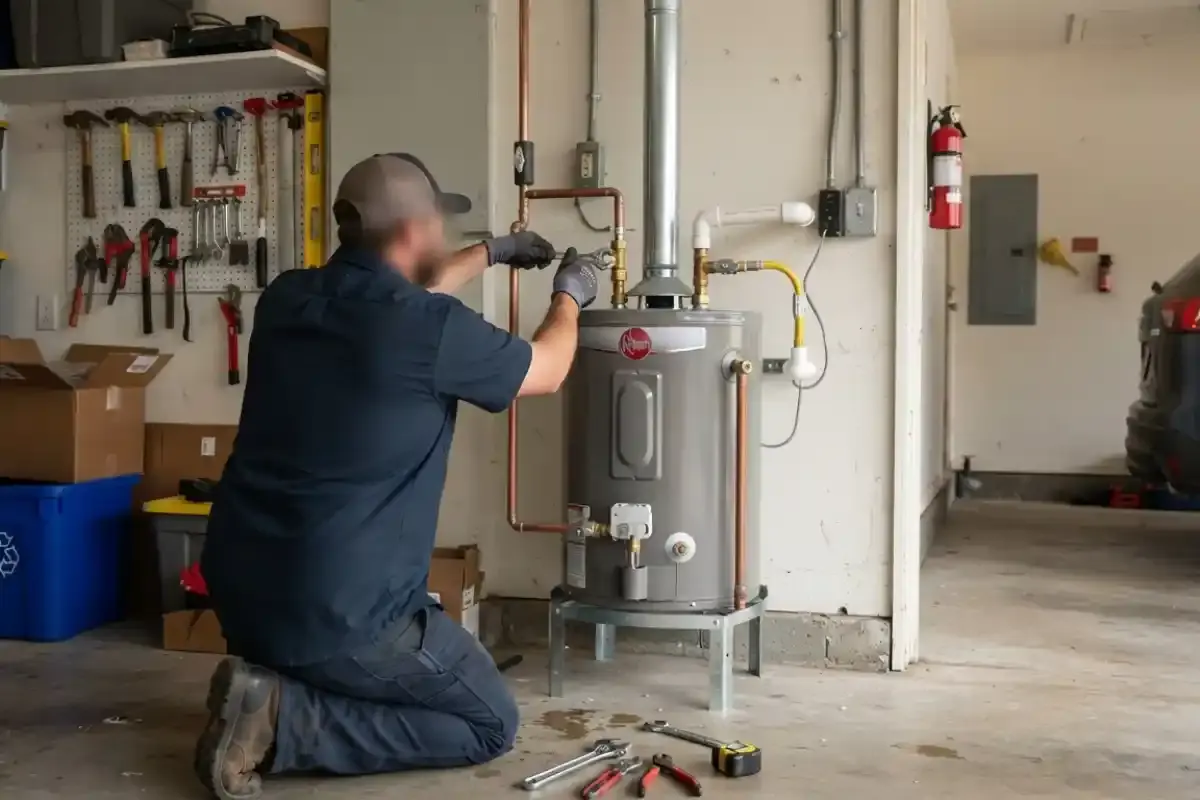
The cost of a 50 gallon gas water heater installation in Casselberry, FL comes down to the job around the tank, not the tank itself. Venting, the gas line, code upgrades, an expansion tank, a drain pan, how easy the heater is to reach and the permit all change the final number.
Two houses can buy the identical heater and end up with very different bills. This guide walks through each factor, explains when 50 gallons is the right size, and shows what to ask before you agree to a price.
What changes the price of a gas water heater install
A clean swap of one 50 gallon gas tank for another is the cheapest case, and our water heater replacement visits start from that baseline. Every row below can push the job up from that baseline, and a good quote names each one out loud.
| Factor | Why it matters | Effect on the job |
|---|---|---|
| Venting | Flue pipe must slope up, stay sealed and clear the draft hood | Reusing a sound vent is simple, replacing it adds parts and labor |
| Gas line | Shutoff, sediment trap and flex connector must suit the new unit | Old fittings or a long run add time |
| Code upgrades | Florida Building Code, Plumbing and the manufacturer set the rules | Missing items get added before the tank is signed off |
| Expansion tank | Absorbs pressure when heated water expands | Extra part, plus a pressure check first |
| Drain pan and drain line | Catches a failed tank and sends water outside | Adds material, more if the drain must be rerouted |
| Access | Tight closets, attics and garages slow the haul and the hookup | More labor in cramped spaces |
| Permit | Set by the Casselberry Building Division | Paperwork and an inspection step, so ask the city about the rules |
Venting is the factor that surprises people most
A gas heater burns fuel, so the exhaust has to leave the house safely. In a typical atmospheric-vent tank, hot flue gases rise through a metal vent pipe that climbs at least a quarter inch per foot toward the roof or wall termination. If the old vent has rust holes, loose joints or a dip where condensation can pool, it should not be reused.
The vent is also tied to the size of the heater. A 50 gallon tank usually has a different burner rating than a 40, and the vent diameter must match the manufacturer's table. That is why a plumber looks at the flue before quoting rather than after the tank is in the driveway.
Leave this one to a licensed plumber. A bad vent can spill carbon monoxide into living space, and nothing about it is a good weekend project.
The gas line and connector
Behind most gas heaters you will find a shutoff valve, a short vertical pipe called a sediment trap (a drip leg), and a flexible connector. The drip leg catches debris so it does not reach the gas control valve. Many older installs skip it, and adding one is a common upgrade.
Flex connectors are single use in practice. Reusing a decades-old connector on a new heater is a bad trade because it costs little to replace and a lot to get wrong. After the job, every joint gets a leak test with a bubble solution, and you should smell nothing.
If the existing gas line is too small, too long or corroded, that adds scope. A plumber can tell you at the walk-through whether the line needs more than a new connector.
Code upgrades, expansion tank and pan: what a good quote lists
Rules differ by house and by year, so treat this list as questions to ask, not a promise of what your job needs.
- Ask whether the water supply has a check valve or backflow device, because that closes the system and makes an expansion tank worth discussing.
- Ask what pressure the house runs at. Pressure above about 80 psi shortens the life of any tank and fixtures, and a regulator may be on the table.
- Ask if a temperature and pressure relief valve and a discharge pipe will be installed to the manufacturer's rules.
- Ask about a drain pan with a drain line, especially if the heater sits in a garage closet, attic or above finished space.
- Ask if the water shutoff upstream of the heater is a ball valve that actually closes. Old gate valves often fail when turned.
- Ask who pulls the permit and whether an inspection is part of the price.
When 50 gallons is the right size
Tank size is about the first hour of demand, not the total gallons in the house. A 50 gallon gas heater recovers fast, because gas burners heat water far quicker than a standard electric element. That is why a 50 gallon gas tank often performs like a larger electric one.
For a household of three to five people with one or two full bathrooms, 50 gallons is a sensible fit. Add a soaking tub, a second shower running at the same time, or a teenager with long showers, and you start to push it.
Going up to 75 gallons helps big families but costs more to buy and takes more floor space. The same sizing logic holds for homes we reach in Longwood and Oviedo. Going down to 40 saves money until the first morning two showers and the dishwasher overlap.
Size decision table: 40, 50 or 75 gallons
| Household | Usual fit | What to watch |
|---|---|---|
| 1 to 2 people, one bath | 40 gallons | Soaking tub fills can run it out |
| 3 to 5 people, 1 to 2 baths | 50 gallons | Two showers plus laundry at once |
| 5 or more people, 3 baths | 75 gallons or two units | Floor space and flue size |
| Single occupant who wants low cost | Smaller tank or tankless | Gas line and vent change for tankless |
Size the new tank to the old closet
A 50 gallon tank is taller and wider than a 40. In a tight closet the flue draft hood, the T&P valve and the clearances around the burner can stop the swap from working. Measure the closet before you pick a model, and keep combustible items out of that space.
What happens on install day
A standard replacement follows the same order whether the heater is in a garage or a closet.
- The gas is shut off at the valve, the water supply is closed, and the old tank is drained to a hose.
- The old heater is disconnected from the flue, gas line and water lines, then carried out.
- The new tank is set in the pan, leveled, and the water connections and relief valve are installed.
- The expansion tank, if needed, is added to the cold line and charged to match house pressure.
- The flue is reconnected with the proper slope and screws, and the gas connector is attached with a drip leg.
- Gas joints are leak tested, the tank is filled with the hot tap open to purge air, and the burner is lit and checked.
What decides your number on a 50 gallon gas heater
Plumbers quote by adding up the pieces. These are the pieces that move the total the most on gas installs.
Heater model and efficiency
Standard-efficiency tanks cost less than higher-efficiency or condensing models, which need different venting.
Vent condition
A reusable, properly sloped flue is a small line item. A new vent run, new termination or liner is not.
Gas piping scope
A new flex connector and drip leg are routine. A re-run line or larger pipe changes the labor.
Code and safety parts
Expansion tank, T&P discharge, pan and strapping items add to the material list when they are required.
Access and haul-away
Attics, tight closets and long carries add labor, and the old tank has to leave the property.
Homeowners insurance usually covers sudden and accidental water damage, but typically not the failed heater itself or gradual leaks and wear. Check your policy. We give a clear price before work starts.
Casselberry notes: permits and who to ask
Water heater work runs through the City of Casselberry Building Division, which sits under Community Development at 95 Triplet Lake Drive. The city has an online permit portal, and its fee schedule includes a plumbing and gas permit category. Permit rules vary, so ask the Casselberry Building Division before you assume your job does or does not need one.
The division is open Monday through Thursday, 7:00 a.m. to 6:00 p.m., and inspections run Monday through Thursday. If your heater fails on a Friday night, plan for that calendar when you ask about inspection timing. Contractors upload a current state license, workers' compensation proof or exemption, general liability insurance and a business tax receipt with each application, so confirm any bidder can show those before you sign.
You can also check a license yourself at MyFloridaLicense.com using Verify a License, searching by business name and by the individual qualifier.
Sources and standards used: City of Casselberry Building Division page, City of Casselberry permit and fee schedule, Florida DBPR MyFloridaLicense.com
Frequently asked questions
A pan is a smart add-on wherever a leak would damage drywall, flooring or a room below. A plumber can run the pan drain to a safe spot outside or to an approved drain. Ask what your installation rules and the manufacturer instructions call for.
The water side is within reach for a skilled DIYer, but the gas connection and the vent are not. A bad gas joint or a leaking flue can cause a fire or carbon monoxide exposure. This is a licensed plumber job, and permit rules vary, so ask the Casselberry Building Division.
Many tanks run roughly 8 to 12 years, with the anode rod and sediment buildup affecting the end of life. Flushing the tank and checking the anode on a schedule can stretch that. A tank that leaks from the shell is finished, and no repair fixes it.
Tankless units give a steady flow of hot water but need a bigger gas line and a different vent, so the install scope grows. They suit some homes and not others. If you want to compare, ask for both options priced side by side.
The city lists a plumbing and gas permit category in its fee schedule and takes applications through an online portal at the Building Division, 95 Triplet Lake Drive. Whether your job needs one varies, so ask the division directly. Inspections run Monday through Thursday, which matters if you want the heater signed off quickly.
Still not sure which answer fits? Describe it to a licensed plumber.
Call (407) 964-8940Plumbing help for this problem
Related services:
Nearby towns we serve: