
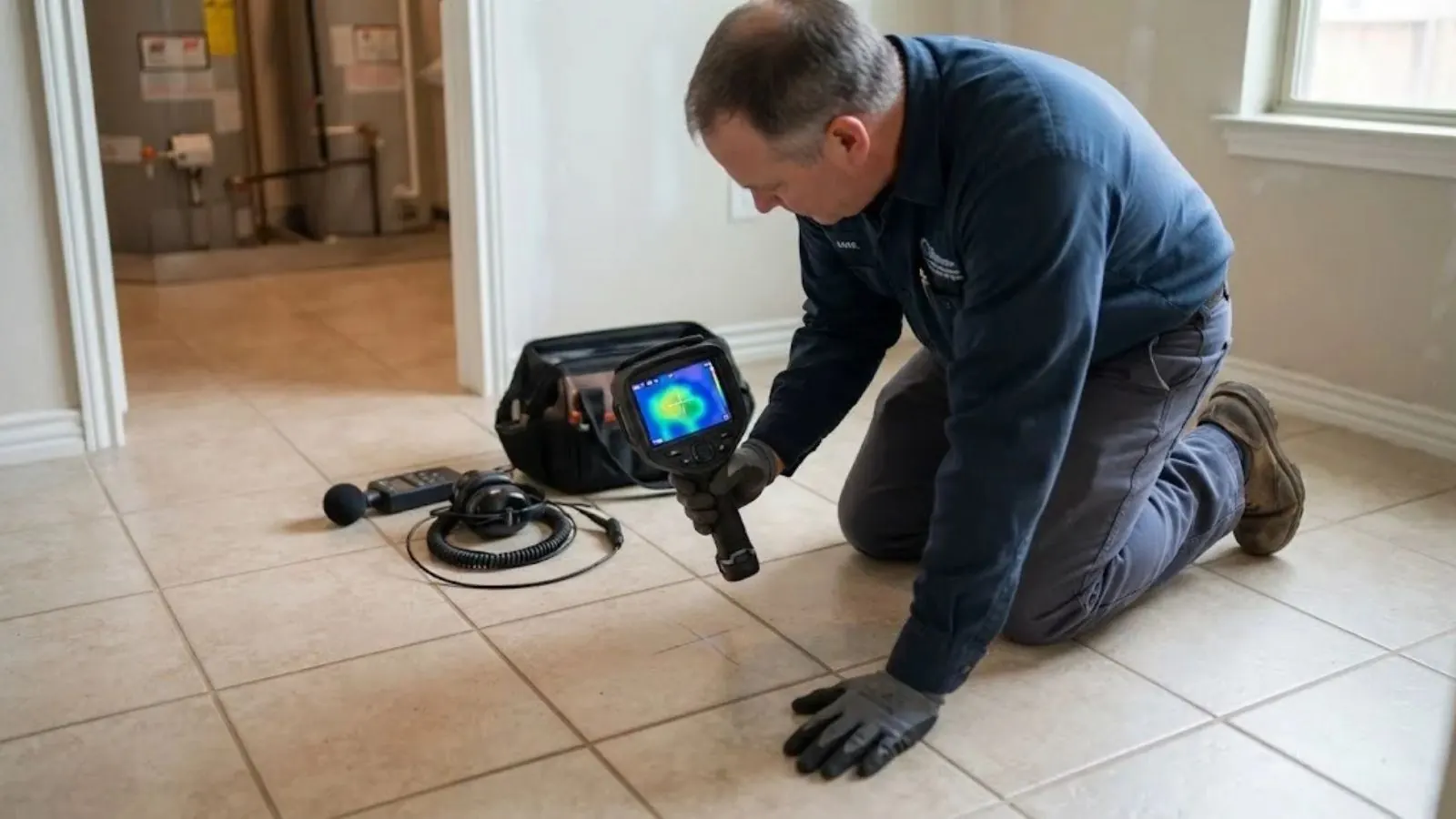
The fastest way to detect a leak in a pipe is to prove one exists, then narrow it down. Read your water meter with everything off, and if it moves, you have a leak. Then check fixtures one at a time, look at the irrigation line, the hose bibs and the area around the water heater, and watch for stains, sounds and smells.
This routine works for any pipe in a Casselberry, FL house. It takes about an hour, needs a flashlight, paper towels and food coloring, and tells you whether to fix a fitting yourself or call a plumber.
Signs of a pipe leak and what each one suggests
Most leaks announce themselves in more than one way. Match what you notice to the table, then confirm with the checks below.
| Sign | Likely source | First place to look |
|---|---|---|
| Brown stain on the ceiling | Supply or drain line above, or a roof leak | The room above, the attic, the bathroom stack |
| Hissing or dripping in a wall | Pressurized supply line | The wall behind the fixture, the water heater closet |
| Musty smell with no visible water | Hidden dampness behind a wall or under a cabinet | Under sinks, behind the washer, inside cabinets |
| Water bill creeping up | Silent leak: toilet, irrigation, buried line | Meter, toilets, yard |
| Low pressure at one or more taps | Leak between meter and fixtures, or a clogged aerator | Main shutoff, yard, aerators |
| Warm or wet spot on the floor | Hot line leaking under the floor | Hot-side fixtures and floor above the slab |
Is the meter still running? Prove the leak first
A meter check separates real leaks from noise. Do it before you tear anything apart.
- Turn off every faucet, the dishwasher, the washing machine and the ice maker, and confirm no toilet is filling.
- Open the meter box, lift the lid and look at the small leak indicator on the dial.
- If it spins or twitches, write the reading and time down, then wait 30 to 60 minutes with nothing running.
- Read the dial again. A change means water is leaving the system somewhere between the meter and a fixture.
- Close the main shutoff inside the house and look at the meter again. If it still moves, the leak sits outside, before the shutoff.
Fixture-by-fixture dye and paper-towel checks
Once the meter confirms a leak, work through the house in order. Most small leaks hide in a handful of places.
- Drop 10 drops of food coloring into each toilet tank, wait 15 minutes without flushing, and see whether color reaches the bowl.
- Wipe supply lines under each sink and behind each toilet with a dry paper towel and check it for damp spots.
- Dry each shutoff valve stem and the supply nut, then press a fresh towel against it. A damp tip means a weeping packing nut.
- Look around the base of faucets and shower arms for mineral crusts, which show slow drips.
- Run the washer and dishwasher hoses with a flashlight and look for bulging, cracking or rust on the fittings.
- Check the hot water side separately by touching the pipe near the heater. A warm pipe with no flow can mean a pinhole leak.
Hose bibs, the water heater and the areas people skip
A hose bib that drips with the hose off is losing water every hour. A bib that drips only with the hose on points to a worn packing nut or a bad vacuum breaker. Look at the wall behind the bib as well, because a split inside the wall shows as a stain on the inside.
At the water heater, check three places: the T&P valve discharge pipe, the cold inlet and hot outlet fittings, and the bottom of the tank. A drip from the discharge pipe can mean high pressure. Rust at the base means the tank itself is failing, and that is a replacement, not a repair.
Checking the irrigation line without a shovel
Irrigation causes many hidden leaks because the pipes run underground. Turn off the controller, then watch the meter. If it still moves with the main closed inside the house, the line from the meter to the yard may be leaking.
Walk the yard with the zones running, one at a time. A soggy patch, a sprinkler head that bubbles or a zone with weak spray points to a break. Pressure also drops in the house when the zone is on, which tells you the leak is upstream of the head.
When a small leak becomes an emergency
A spurting pipe, a ceiling bulging with water, or water near electrical outlets is not a triage job. Close the main shutoff, switch off power to wet areas at the breaker if you can do so safely, and call. Our burst pipe repair team treats a flooding house as urgent, and the 24/7 line is (407) 964-8940.
What you can fix and what to leave to a plumber
A homeowner can tighten a packing nut, replace a toilet flapper, swap a worn supply line or replace a hose bib washer. These need a bucket, a wrench and about an hour.
Stop at anything inside a wall, anything under a floor, any leak that persists after a fitting fix, and any gas or electrical contact. A plumber who finds the source before cutting drywall saves you a bigger patch later, and a proper leak detection visit does that.
What shapes the cost of tracking down a leak
Detection and repair are priced as separate pieces of work. These factors change the detection side.
Where the leak sits
A supply line under a sink takes minutes. A line inside a wall or under a yard takes tools and time.
How many leaks there are
A single dripping fitting is simple. Multiple leaks or aging pipe need a broader check.
Equipment needed
Moisture meters, acoustic gear, cameras and pressure gauges each add to the visit.
Access
Finished walls, tile and landscaping make it slower to reach the pipe.
Repair that follows
Drywall, flooring or sod repairs, if any, are a separate scope from the plumbing.
Homeowners insurance usually covers sudden and accidental damage, but typically not the leaking pipe itself or gradual leaks and wear. Check your policy. We give a clear price before work starts.
Casselberry notes: irrigation, reclaimed water and your bill
The City of Casselberry has 42 miles of reclaimed water main, available only in some areas, and the city encourages connecting where it is offered. Where reclaimed water is not available, a separate potable irrigation meter can lower the bill because irrigation water is not charged sewer treatment fees. Ask the City of Casselberry Utilities Department whether either option applies to your address.
Irrigation hours follow rules set with the St. Johns River Water Management District, and watering is not allowed from 10 a.m. to 4 p.m. If you test your sprinkler zones, do it outside that window, and check the city page for your allowed days.
These details matter for leak hunting because an irrigation leak is often the reason a bill rises with no change inside the house.
Sources and standards used: City of Casselberry Utilities Department irrigation and reclaimed water page, St. Johns River Water Management District restrictions (via city page)
Frequently asked questions
Look for a stain, bubbling paint, a soft spot or a warm patch on the surface. Listen for hissing with all water off. A meter that moves with the fixtures closed adds to the evidence, and a plumber can then trace the line.
A running toilet flapper, an irrigation break or a buried line can leak without showing. Read the meter with everything off to prove it. Then use the dye test and the yard walk to narrow it down.
Yes. A slow drip adds up over a month and can soak the wall around it over time. Replacing the packing or washer is simple, but a split inside the wall needs a plumber.
The checks are the same anywhere. The utility and building department differ, since Winter Park is in Orange County and Oviedo runs its own city utility. See our Winter Park and Oviedo pages for local details.
Yes, if the meter moves with the main open and everything off, the leak is inside the house. A moving meter with the main closed means the leak is before the shutoff, which is a different repair.
It can. The city says irrigation water on a separate potable irrigation meter is not charged sewer treatment fees, so a yard leak on that meter is billed differently from a leak inside the house. Ask the City of Casselberry Utilities Department how your account is set up.
Still not sure which answer fits? Describe it to a licensed plumber.
Call (407) 964-8940Plumbing help for this problem
Related services:
Nearby towns we serve: