
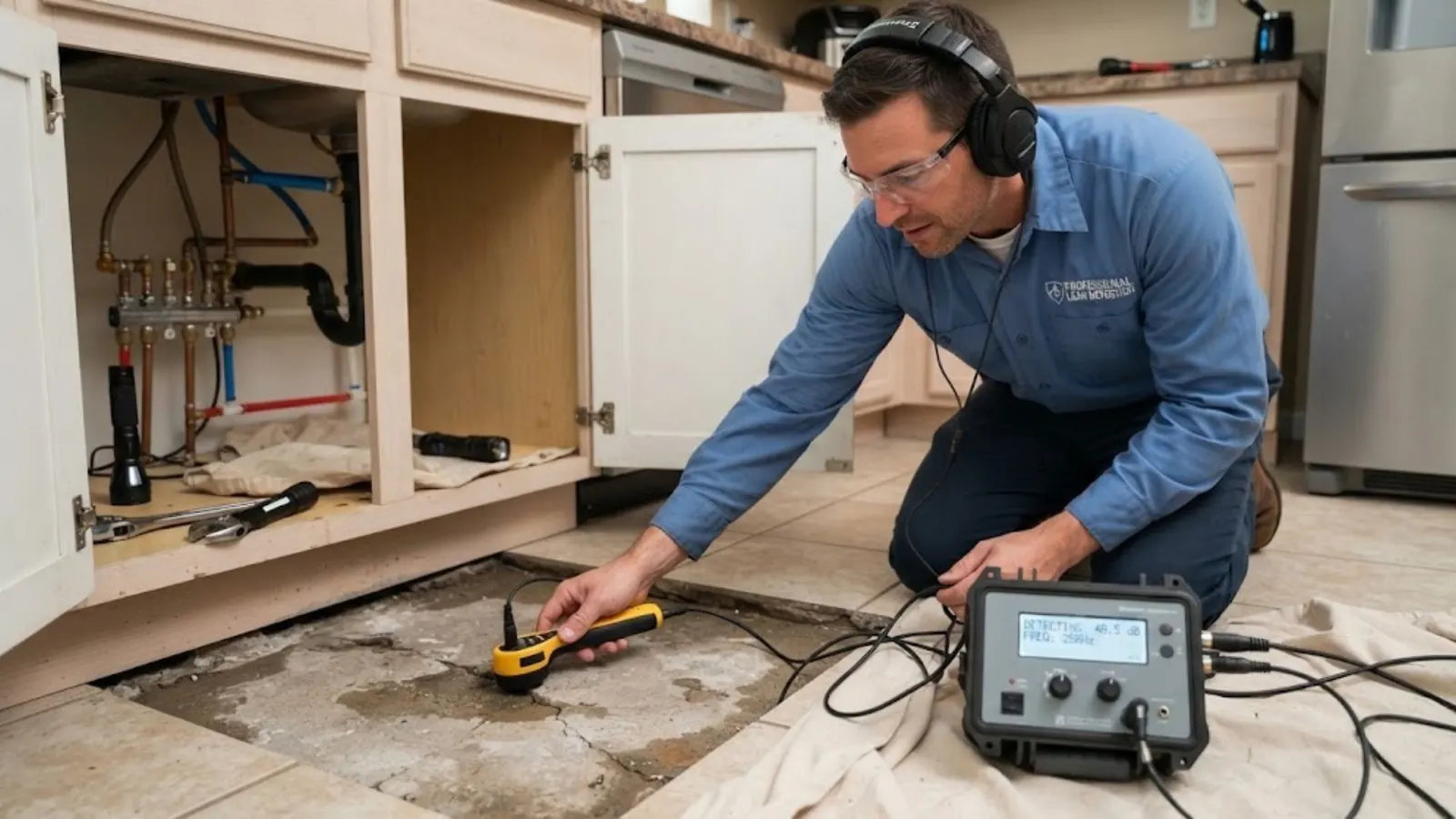
To detect a water leak under a slab in Casselberry, FL, start with the meter. Shut off every fixture, check that the leak indicator on your water meter is still spinning, then confirm with a pressure test on the house lines. Plumbers then pinpoint the spot with acoustic listening, thermal imaging, tracer gas or a line locator.
You can do the first two steps tonight with no tools. The rest need equipment, and the order matters, because each method answers a different question. This guide explains what each method finds and what the results mean.
Checks you can do tonight
These need no tools and take about half an hour. Write down what you see so you can tell the plumber.
- Turn off every faucet, the ice maker, the irrigation controller and the washing machine, and make sure no toilet is running.
- Find the water meter, lift the lid and look at the leak indicator, a small triangle or dial. If it moves, water is leaving the system.
- Write down the meter reading, wait an hour with nothing running, and read it again.
- Walk barefoot across the floors and note any warm spot, which can mean a hot line is leaking below.
- Listen in a quiet house for a faint hiss or the sound of running water when everything is off.
- Check baseboards, tile grout and carpet edges for dampness, stains or a musty smell.
Detection methods compared: what each one finds
No single tool does everything. Plumbers combine methods, starting with the cheapest and least invasive.
| Method | What it answers | Limits |
|---|---|---|
| Meter test | Is water leaving the house at all? | Cannot say where |
| Pressure drop test | Is the leak on the supply side, and hot or cold? | Needs isolating sections of pipe |
| Acoustic listening | Where is the sound of escaping water loudest? | Noise from traffic or fixtures can mask it |
| Thermal imaging | Is there a warm patch on the floor over a hot line? | Works for hot lines, weak for cold ones |
| Tracer gas | Which section of pipe is leaking? | Needs the line emptied and filled with gas |
| Line locating | Where is the pipe under the slab running? | Does not find the leak by itself |
The meter test and what a moving dial means
Your water meter measures everything that passes through the house line. With all water off inside and out, the low-flow indicator should sit still. A slow creep means a small leak, and a steady spin means a large one.
That tells you something is leaking, but not whether it sits in the slab, in the yard, or in a toilet flapper. If the meter moves with the main shutoff closed, the leak is on the utility side of that valve. If the meter stops, the leak is inside the house, which is where the next test comes in.
Pressure drop test: finding which line is leaking
A plumber caps off the house supply and attaches a gauge. If the gauge falls with all fixtures closed, the leak sits somewhere in the piping. By isolating the hot side from the cold side, they learn which branch is losing water.
A warm floor and a drop in pressure on the hot side together point strongly to a slab leak on the hot line. A cold-side drop with no warm spot may be a cold line, a service line or a fixture valve. This step narrows the search to a handful of pipe runs.
Acoustic listening and thermal imaging
A leak under pressure makes a hiss or a roar, which travels through the pipe and the concrete. A technician places a sensitive ground microphone on the floor and walks a grid, listening for the loudest spot. The sound is strongest right above the leak, and that spot is where a repair would start.
Thermal cameras read surface temperature. A leaking hot line warms the slab, and the camera shows a bright patch, sometimes a few feet wide. Cold leaks are harder to see, so a camera result of nothing does not rule out a slab leak.
Our leak detection visits combine both, because sound and heat check each other.
Tracer gas and line locating
When sound and heat do not agree, the plumber can fill the empty line with a harmless mix of hydrogen and nitrogen. The gas is lighter than air, so it rises through the slab at the break. A sniffer tool picks it up, and that is accurate to a few inches.
A line locator sends a signal along the pipe and shows its route under the floor. It does not find the leak, but it tells you where the pipe runs before anyone cuts concrete. Knowing the route prevents a hole in the wrong place.
The sequence a plumber follows
- Shut off all water use and read the meter, then close the main valve and see whether the dial stops.
- Pressure test the house lines and isolate hot from cold to find the leaking side.
- Locate the pipe route with a line tracer so the search zone is clear.
- Listen on the floor with an acoustic microphone and mark the loudest points.
- Scan with a thermal camera to compare heat and sound results.
- Confirm with tracer gas if the other methods disagree, then mark the spot.
What a clean result still can mean
A leak can hide for a while. Tests run on a dry day with the soil already damp may mislead, and a small cold-water drip may be too quiet to hear. If the meter keeps moving and nothing is found, ask the plumber to repeat the pressure test, since the meter does not lie.
What shapes the cost of finding a slab leak
Finding a leak is priced separately from fixing it. Here is what moves the detection price.
Number of methods needed
A clear meter and acoustic result is quick. A disputed result needs thermal, tracer gas or a second visit.
House size and pipe layout
A larger slab with branching lines takes longer to map and listen across.
Floor coverings
Carpet and tile change how sound and heat travel, and thick tile slows the search.
Hot or cold line
Hot-line leaks show up on thermal. Cold-line leaks lean on sound and tracer gas.
Access to the main and valves
Shutoffs that seize or sit behind fixtures slow isolation testing.
Homeowners insurance usually covers sudden and accidental damage, but typically not the failed pipe or gradual leaks and wear. Check your policy. We give a clear price before work starts.
Casselberry notes: the meter, the utility and older houses
The City of Casselberry Utilities Department supplies your water and reads your meter. If your meter keeps moving with everything off, ask the department how your bill is structured, because sewer charges may follow the water you use. A leak you cannot see may cost you on both sides of the bill.
Casselberry grew from 9,438 people in 1970 to 18,911 in 1990, which suggests much of the housing likely dates from the 1960s to the 1980s. The Seminole County property appraiser record shows the build year of your house, and that tells you how old the pipes under your floor are likely to be.
The city's 2025 Consumer Confidence Report says it does not have lead service lines. That describes the city supply. It does not tell you what is under your slab, so a leak test is the way to learn.
Sources and standards used: City of Casselberry 2025 Consumer Confidence Report, City of Casselberry Utilities Department, US Census population figures, Seminole County Property Appraiser (general)
Frequently asked questions
Turn off all water inside and out and look at the leak indicator. If it moves, water is leaving the system. Closing the main shutoff and checking again shows whether the leak is before or after the valve.
Yes. Pressure testing, listening, thermal imaging and tracer gas all work from the surface. Concrete is opened only after the leak is located, and then only at that spot. That repair is its own job, covered on our slab leak repair page.
No. Sun through a window, a heating duct or a water heater nearby can warm a floor. A warm patch plus a moving meter plus a drop in hot-side pressure makes a leak likely.
Close the main shutoff if you hear water running or the floor is wet. That limits damage while you wait. Keep the heater switched off if the tank is drained.
Still not sure which answer fits? Describe it to a licensed plumber.
Call (407) 964-8940Plumbing help for this problem
Related services:
Nearby towns we serve: